
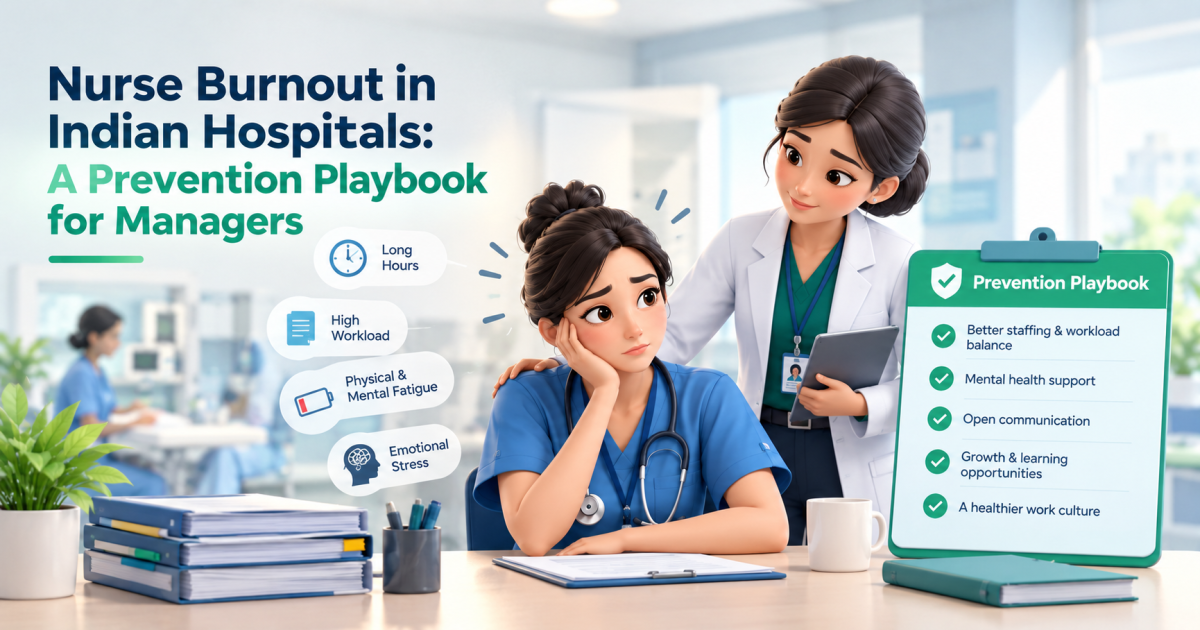
If you manage nurses in an Indian hospital, you already know burnout is real. You see it in the extra sick leave, the constant shift swaps, the tired faces at handover, and the good nurses who quietly start looking for other jobs.
The tricky part is that burnout symptoms don’t appear overnight. They build up slowly, and by the time you notice, someone has often already decided to leave.
The pressure is not going to ease on its own.
The WHO’s State of the World’s Nursing 2025 report projects that the global nurse shortage will still stand at around 4.1 million in 2030, which means hospitals everywhere will keep competing for the same experienced nurses.
This blog is written for nurse managers, nursing superintendents, and hospital HR heads.
It covers what really drives burnout, the burnout symptoms worth tracking, and the rostering, ratio, and staffing changes that make a measurable difference.
What Burnout Symptoms Look Like on an Indian Hospital Floor
Burnout is not the same as a tiring week. It is a long-running state of exhaustion that changes how a nurse feels, thinks, and works.
Managers usually see burnout symptoms in two places: in the person and in the data.
The second matters more, because data can be measured and tracked over time.
Physical and Emotional Burnout Symptoms You Can Notice During Ward Rounds
Key points to watch for:
- Constant tiredness that does not lift even after a weekly off
- Frequent headaches, body pain, acidity and poor sleep, especially after night rotations
- Irritability with colleagues, patients or attendants
- Emotional distance from patients and less patience with family questions
- A feeling that their work no longer makes a difference
These burnout symptoms are easy to dismiss as a passing mood. The difference is persistence. When the same nurse shows them for weeks at a stretch, treat it as a workload issue, not a personality issue.
Behavioural Burnout Symptoms That Show Up in Roster and HR Data
- More short-notice sick leave, especially around night duties and double shifts
- Late arrivals and early sign-outs from nurses who were always punctual
- More medication errors, missed vitals and incomplete charting
- Requests to move out of high-acuity units
- Senior nurses who stop volunteering for training, mentoring or committee work
Behavioural burnout symptoms are your early-warning system. You do not need a nurse to tell you she is burning out when her sick days, error reports and transfer requests already say it.
Nursing Burnout Causes: Why It Is Usually a Staffing-Maths Problem
Many hospitals respond to burnout with wellness sessions or motivational talks. These have their place, but they do not touch the core issue.
In most Indian hospitals, the main causes of nursing burnout trace back to one equation: the nurse-shifts a ward needs versus the nurse-shifts the team can actually supply.
How the Staffing Gap Creates Nursing Workload Stress
Every unit has a demand side and a supply side. Demand is the number of nurses needed per shift at your target ratio, multiplied across every shift in the week.
Supply is the number of nurses actually available, multiplied by the shifts each one works, after subtracting leave, vacancies, training days, and long absences.
Most hospitals plan only for demand. They calculate headcount to fill the roster on paper and forget the leave reserve. Then vacancies sit open while approvals move slowly, and someone goes on long leave.
Supply drops, demand stays the same, and the difference does not disappear. It gets filled with double shifts, cancelled offs, and patients quietly receiving less attention.
That gap is where nursing workload stress really comes from. When a manager asks why everyone is exhausted, the honest answer usually sits in this calculation, and the burnout symptoms on the ward are simply its visible result. Getting sanctioned strength right starts with sound hospital manpower planning that builds the leave reserve in from day one.
Other Nursing Burnout Causes That Make the Staffing Gap Worse
- Non-nursing tasks: billing follow-ups, pharmacy runs, insurance paperwork, and attendant management pull nurses away from patient care
- Acuity mismatch: ratios set by bed count ignore how sick the patients actually are
- Students counted as staff: trainees fill ratio numbers without carrying a full patient load
- Weak handovers: unstructured handovers stretch every shift past sign-out time
- No growth path: experienced nurses feel stuck with no route to senior or specialist roles
- Attendant pressure: aggressive family members, with little backup from security or administration
Ratio Guardrails That Stop Nursing Workload Stress Before It Breaks a Shift
A ratio written in a policy file means little if nobody acts when it slips. A guardrail is a ratio plus a clear rule about what happens when it is breached.
How to Set Ratio Guardrails by Unit, Acuity and Shift
- Two numbers per unit: set a target ratio and a red-line ratio for every unit, with critical care units held to far tighter limits than general wards
- Acuity scoring every shift: a simple score per patient shows the in-charge when the workload is heavier than the headcount suggests
- Clean counting: never count students, interns, or in-charges with full admin duties toward the ratio
- Separate night ratios: define night staffing on its own terms instead of trimming the day roster
What Should Happen When a Ward Crosses the Red Line
- The in-charge escalates to the nursing supervisor within the hour
- A float nurse is deployed first
- If no float nurse is available, admissions to that unit are paused or redirected where clinically safe
- Every breach is logged and reviewed weekly by the unit
The logging matters most. Repeated breaches on the same ward are not bad luck. They are a staffing decision someone needs to own, and that ward is usually where burnout symptoms appear first.
Rostering Changes That Prevent Nurse Burnout: Hospital Shift Rules That Work
Roster design is the fastest lever a manager has. These changes cost very little, and nurses notice them within weeks.
1. Cap Consecutive Nights and Protect the Weekly Off From Last-Minute Cancellation
Limit how many night duties a nurse works in a row, and follow every night block with proper recovery time. Treat the weekly off as protected. If an off must be cancelled, it should need supervisor sign-off and a compensatory off within the same fortnight. When offs are cancelled casually, nurses stop trusting the roster, and that loss of trust shows up quickly as burnout symptoms and sick calls.
2. Publish the Roster Early and Give Nurses Some Control Over Their Shifts
- Publish rosters weeks in advance, not at the end of the previous week
- Open a short self-rostering window where nurses mark preferences before the roster is finalised
- Run shift swaps through a formal process approved by the in-charge instead of informal group chats
Predictability is protective. A nurse who knows her coming weeks can plan her family life, her sleep and her travel, and that alone eases a large share of nursing workload stress.
3. Share Hard Shifts Fairly and Stop Using Double Shifts as the Default Fix
Track who works Sundays, nights and festival days, and rotate them fairly across the team. Set a monthly cap on double shifts per nurse. If a ward keeps needing more than that cap, it is no longer a rostering problem. It is a clear signal to raise sanctioned strength or bring in float staff.
Workload Monitoring: Early-Warning Signs Every Nurse Manager Should Track
Individual burnout symptoms tend to surface late. Workload data shows the problem earlier. Track a small set of indicators every month, unit by unit, and compare each unit against its own baseline.
| Indicator | What to watch for | Manager action |
| Overtime hours per nurse | Sustained rise over consecutive months | Review roster and open vacancies |
| Double shifts per nurse | Crossing your monthly cap | Deploy float staff, raise a headcount request |
| Short-notice sick leave | Clear rise above the unit’s usual level | Check night and double-shift patterns, hold one-on-ones |
| Missed breaks | Becoming routine rather than occasional | Remove non-nursing tasks from the unit |
| Ratio red-line breaches | Repeating in the same unit | Escalate to administration |
| Incident and error reports | Sustained upward trend | Check staffing on those shifts before blaming individuals |
| Transfer or resignation requests | Clustering in one unit | Run stay interviews in that unit |
Set your baseline over the first quarter, then act on movement rather than single spikes.
-
Use a Monthly Pulse Check to Track Staff Wellbeing in Your Hospital
Run a short anonymous survey with five questions:
- Did you get your breaks on most shifts this month?
- Was your workload manageable?
- Do you feel safe raising concerns with your in-charge?
- Would you recommend this unit to a fellow nurse?
- Are you considering leaving in the next six months?
Trend the scores by unit, not just hospital-wide. Staff wellbeing in a hospital improves when nurses see results shared openly and at least one visible change each quarter. A survey with no follow-up does more harm than no survey at all.
The Burnout and Retention Link in Nursing That Managers Cannot Ignore
Burnout, retention, and nursing quality are tied together in a loop. Every nurse who leaves because of exhaustion widens the gap for those who stay. The remaining team picks up extra shifts, develops more burnout symptoms, and the next resignation comes faster.
Hospitals that try to fix this only at the exit stage, with counter-offers and exit interviews, stay one step behind.
The way to break the loop is at the staffing end: close the shift gap, enforce guardrails, and protect rosters.
Once that foundation is in place, career paths, recognition, and fair pay structures from proven nurse retention strategies keep your experienced nurses from walking out.
Build a Float Pool So One Absence Does Not Break the Whole Shift
A float pool is a group of cross-trained nurses who are not tied to one ward. They are deployed wherever a ratio guardrail is breached. It is the most direct answer to the staffing maths behind burnout, because it adds capacity exactly where and when it is missing.
How to Size and Structure a Nursing Float Pool
- Size it from your own data: base the pool on your average daily unfilled shifts over recent months, plus a buffer for sudden absences
- Cross-train across unit types: a float nurse should be useful on day one, wherever they are sent
- Pay a float allowance: floating is harder than working a fixed ward, and pay should reflect that
- Blend staffing models: keep a core of permanent float nurses and add contract nurses for seasonal surges, using a balanced mix of permanent and temporary healthcare staffing rather than relying on one model alone
When an External Staffing Partner Makes More Sense Than Hiring Alone
Building a float pool from scratch takes time. An external partner is usually the faster route when you are opening a new wing, facing a cluster of resignations, covering long leave or handling a seasonal rise in admissions.
Pre-verified nurses who can join within days stop the gap from turning into another wave of burnout symptoms on your busiest wards.
Flexible medical staffing solutions let you scale your float capacity up or down without long hiring cycles.
Run a Burnout Risk Audit in Your Hospital in 30 Days
You do not need a consultant or a large budget to find out where burnout is building. Here is a four-week plan:
- Week 1: Pull the data. Collect recent rosters, overtime, sick leave, vacancies and ratio breaches for every unit.
- Week 2: Calculate the gap. Compare nurse-shift demand with real supply in each unit to find the weekly shortfall.
- Week 3: Listen. Run the pulse survey and hold short one-on-ones with every in-charge. Map reported burnout symptoms against the staffing gap.
- Week 4: Act. Rank units red, amber or green. Fix roster rules, set guardrails, decide your float-pool size and raise hiring requests for red units first.
Want this done for you? Staffton Health runs a free burnout risk audit for hospitals. We map your unit-wise staffing gap, flag high-risk wards and recommend the right float-pool size and staffing mix.
Hospitals that want a clear picture of where their nursing team is under the most pressure can book a free burnout risk audit with our team.
Frequently Asked Questions
1. What are the early burnout symptoms in nurses?
Early burnout symptoms include constant tiredness even after rest days, emotional detachment from patients, irritability with colleagues and attendants, small charting or medication slips, and pulling away from the team. In your data, look for rising unplanned leave, frequent shift swaps, and overtime falling on the same few nurses.
2. What are the most common nursing burnout causes in Indian hospitals?
The most common causes are chronic short-staffing, long runs of night shifts, floating nurses without orientation, heavy documentation, aggression from patient attendants, late rosters, and job insecurity. Most of these are linked to staffing and scheduling decisions rather than individual weakness.
3. How can managers prevent nurse burnout without hiring many permanent staff?
Start with roster fixes like night-shift caps, self-rostering windows and protected breaks. Set acuity-based ratio guardrails with a clear escalation path. Then build a float pool using cross-trained internal nurses and pre-verified external nurses who can cover surges and leave.
4. How often should hospitals check for burnout symptoms in nursing teams?
Review staffing and workload data weekly using a simple red-amber-green tracker, and run a short anonymous pulse survey every month. Checking burnout symptoms this often helps you catch problems while they are still fixable through scheduling changes.
5. Does nurse burnout affect patient safety?
Yes. Exhausted, overloaded nurses are more likely to miss deteriorating vitals, make medication errors, and rush handovers. Fatigue and detachment are burnout symptoms that directly reduce the quality of bedside care, which is why burnout prevention is a patient safety priority, not just an HR one.
Conclusion
Nurse burnout in Indian hospitals is rarely about nurses who can’t cope. It is usually about wards that are asked to do more than their staffing allows, week after week.
The good news is that managers hold most of the levers: fairer rosters, clear ratio guardrails, a weekly early-warning tracker, and a float pool that absorbs shocks before they land on your core team.
Spot burnout symptoms early, treat them as staffing signals, and act on the numbers before you act on morale.
As India’s healthcare hiring platform, Staffton connects hospitals with verified, credential-checked nurses for float-pool, surge, contract and permanent roles across major cities.
Whether you need extra hands for monsoon season, cover for festival leave or a long-term plan to stabilise a high-turnover unit, Staffton helps you close the staffing gap that drives burnout in the first place.