
Every hospital administrator knows the feeling. A senior ICU nurse resigns on Monday, the night shift is short by Wednesday, and the department head is asking who will cover. This is no longer a local problem.
WHO estimates a projected shortfall of 11.1 million health workers by 2030, mostly in low- and lower-middle-income countries. India feels this pressure directly.
As of 31 December 2025, the country had 46.02 lakh registered nursing personnel, a nurse-to-population ratio of 2.60 per 1,000, still under the WHO benchmark of three.
That gap is exactly why hospitals now depend on external hiring partners. But not every vendor is built the same, and a wrong choice costs you far more than a placement fee. Use this checklist before you sign anything.
What Medical Staffing Solutions Actually Include Today
Medical staffing solutions are not just resume forwarding. A serious partner handles sourcing, credential verification, compliance paperwork, onboarding support, and replacement coverage across clinical and non-clinical roles.
Key points:
- Permanent hiring: consultants, resident doctors, senior nurses, department heads
- Contract and locum staffing: short-term cover for leave, surgeries, seasonal load
- Bulk and project hiring: new unit launches, hospital expansion, NABH readiness
- Allied health and support: lab technicians, radiographers, physiotherapists, OT assistants
- Compliance management: registration checks, background verification, statutory documentation
If a vendor only does one of these, you will end up managing three vendors instead of one.
Why Choosing the Wrong Staffing Partner Costs Hospitals More Than Money
A vacant ICU bed earns nothing. An unverified nurse creates legal risk. A doctor who quits in six weeks forces your HR team to restart the whole cycle. The real cost of a bad hire in healthcare shows up as overtime bills, burnout among existing staff, cancelled procedures, poor patient reviews, and accreditation trouble.
This is why the criteria you apply while shortlisting matter more than the price you negotiate.
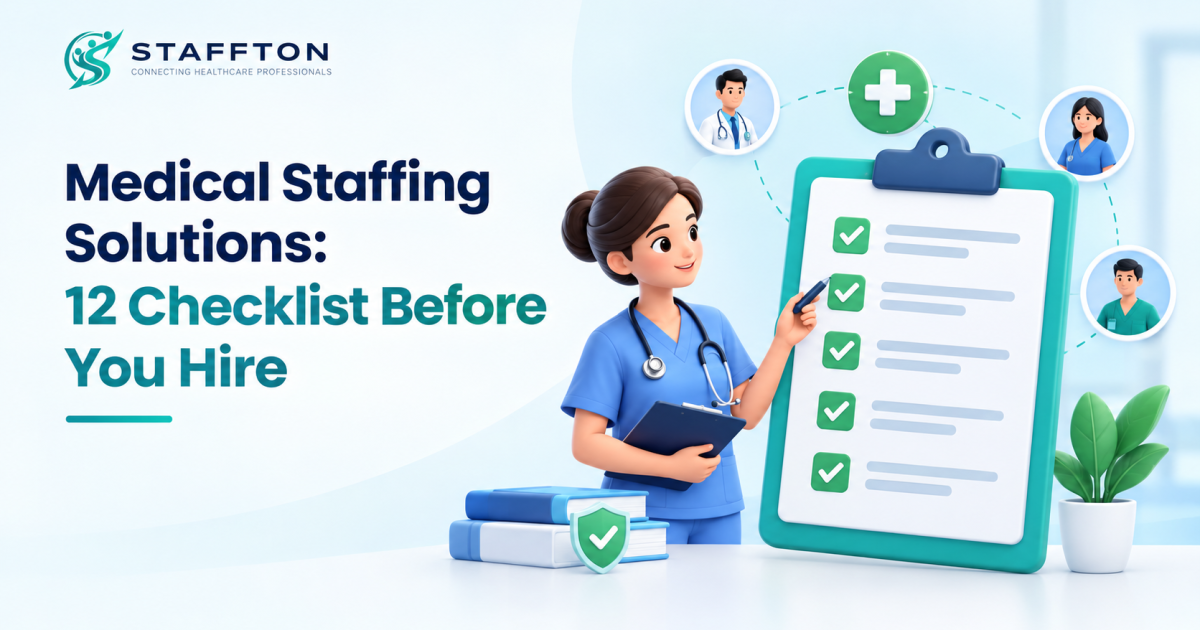
The 12-Point Medical Recruitment Vendor Checklist for Hospitals
Run every shortlisted agency through these twelve checks. Score them out of 12 and compare.
1. Do They Verify Licences and Registrations Before Sending You a Profile?
Ask how the agency confirms NMC or State Medical Council registration for doctors and Indian Nursing Council or State Nursing Council registration for nurses.
The answer should be a documented step in their process, not a promise. Also check whether they validate qualification certificates, internship completion, and renewal dates. If verification happens only after you select a candidate, the risk sits with you, not the vendor.
2. Do They Have Real Depth in Your Specific Specialities and Departments?
A vendor strong in general duty nurses may have almost no pipeline for perfusionists, neonatologists, or cath lab technologists. Ask for placement counts by speciality over the last twelve months.
Request three recent examples that match your open roles. Depth in your departments is one of the clearest signals when you evaluate a staffing vendor for a hospital.
3. Can They Share Honest Time-to-Fill and Fill-Rate Numbers?
Ask two questions: what percentage of assigned roles do you actually close, and what is your average time-to-fill for a senior nurse versus a consultant?
Good partners quote ranges and explain why some roles take longer. Vague answers like “we fill everything quickly” usually mean nobody is tracking the data.
4. Where Do Their Candidates Actually Come From?
A vendor relying only on public job portals is competing with you using your own tools. Ask about their internal verified database size, referral networks, nursing college tie-ups, alumni groups, and repeat locum pools.
Sourcing strength is the difference between a shortlist in three days and a shortlist in three weeks.
5. How Thorough Is Their Background Verification Process?
In healthcare, background checks are patient safety measures. Confirm that they check previous employment, reasons for exit, disciplinary history, address proof, and identity documents. Ask whether verification is done in-house or through a third-party agency, and whether you receive the verification report with the candidate profile.
6. Do They Understand Healthcare Compliance and Accreditation Requirements?
Your staffing partner should know what NABH and JCI assessors look for in staffing files, what documentation contract staff need, and how PF, ESIC and statutory dues work for deputed employees. A vendor from general IT or sales recruitment will not know this, and the gap will appear during your next audit.
7. Can They Handle Permanent, Contract and Locum Needs Together?
Hospitals rarely need one hiring model. You may want permanent consultants, contractual nurses for a new wing, and locum cover for a surgeon on leave in the same quarter. A partner offering all three models under one agreement reduces paperwork, saves negotiation time, and keeps your staffing data in one place.
8. What Is Their Geographic Reach, Especially in Tier 2 and Tier 3 Cities?
Metro hiring is comparatively easy. The real test is filling a radiologist role in a district hospital or a nursing team in a smaller town. Ask which cities and states they have placed in during the past year, and whether they support relocation, accommodation guidance and family settlement for candidates moving to smaller locations.
9. Do They Offer Technology, Tracking and Transparency You Can See?
You should be able to check candidate status without sending follow-up emails. Ask whether they provide a dashboard or applicant tracking access, structured profile formats, interview scheduling support, and weekly reporting. Modern medical staffing solutions run on shared visibility, not on phone calls and scattered WhatsApp messages.
10. What Replacement Guarantee and Retention Record Do They Offer?
Ask for the replacement window in writing 60 days, 90 days, or more and what conditions apply. Then ask a sharper question: what percentage of your placements are still working after one year? Retention data tells you whether they match candidates properly or simply fill seats.
11. Is Their Pricing Model Clear, With No Hidden Costs?
Understand whether the fee is a percentage of annual CTC, a flat fee per hire or a monthly managed-services charge. Clarify GST treatment, payment terms, charges for replacements, and whether bulk hiring gets a different rate. Cheapest is rarely best, but unclear is always bad.
12. Will You Get a Dedicated Account Manager and a Written SLA?
Find out who owns your account, how quickly they respond, and what the escalation path looks like when a critical role stalls. Put response times, shortlist timelines and reporting frequency into a service-level agreement. This single step prevents most disputes later.
Red Flags to Watch for While Shortlisting Any Staffing Agency
- Profiles arrive within hours, but none match the job description
- No documented credentialing or verification process
- Refusal to share client references or placement data
- Same candidate submitted by multiple agencies
- Pressure to sign an exclusive contract before any trial assignment
- No healthcare-specific experience on the leadership team
Staffing Partner Questions to Include in Your Hospital Staffing RFP
If you run a formal process, build these into your hospital staffing RFP so comparison becomes objective:
- How many healthcare placements did you complete in the last financial year?
- Which specialities do you fill most often, and which do you avoid?
- What is your candidate verification workflow, step by step?
- What are your standard SLAs for shortlist, interview and joining?
- How do you handle a candidate who does not join after accepting the offer?
- Can you share two hospital references of similar size to ours?
These staffing partner questions separate marketing claims from operational capability faster than any brochure.
Hiring Trends Shaping Medical Staffing Solutions Right Now
Three shifts are changing how hospitals hire. First, flexible and locum staffing is growing fast, because fixed headcount alone cannot handle seasonal surges and leave cycles. Second, nurse migration abroad continues to pull experienced talent out of Indian hospitals, making retention planning as important as recruitment.
Third, technology-led platforms with verified talent pools are replacing traditional consultancies because hospitals now expect speed, audit-ready documentation, and visible tracking. Any agency that ignores these three shifts will struggle to deliver consistently over the next two years.
FAQs
1. What are medical staffing solutions in simple terms?
They are services that help hospitals and clinics find, verify, and onboard doctors, nurses, allied health professionals, and support staff on permanent, contract, or locum terms while handling documentation and compliance.
2. How do I decide the best medical staffing agency criteria for my hospital?
Score agencies on speciality depth, verification quality, fill rate, compliance knowledge, replacement guarantee, technology access, and pricing clarity. Weight the criteria according to your most critical vacancies.
3. How long does it take to fill a clinical vacancy?
General duty nurses and technicians usually take one to three weeks. Senior consultants and super-speciality roles can take six to twelve weeks, depending on location, package and notice period.
4. Is contract or locum staffing suitable for hospitals?
Yes. It works well for leave cover, seasonal surges, new department launches and trial periods before converting a role to permanent, provided statutory compliance is handled correctly.
5. Should small hospitals and clinics use a staffing partner?
Absolutely. Smaller facilities often lack a full HR team, so an external partner reduces vacancy days and removes the burden of verification and paperwork.
Conclusion: Choose a Partner Who Understands Hospitals, Not Just Hiring
Staffing decisions in healthcare are clinical decisions. Every unfilled shift affects patient care, staff morale, and revenue. Work through this medical recruitment vendor checklist before you commit, ask the hard questions early, and insist on documentation rather than assurances.
Staffton Health connects hospitals, clinics, and diagnostic centres across India with verified doctors, nurses, and allied health professionals through a single platform with credential checks, speciality-wise talent pools, permanent and contract hiring models, and transparent tracking from requirement to joining.
If you are comparing medical staffing solutions for your facility, talk to the Staffton team and see how quickly your open roles can be closed.