
Healthcare staffing is one of the biggest workforce decisions hospitals make because it affects patient care, employee workload, and operating costs.
According to the American Hospital Association, labor costs accounted for 56% of total hospital expenses in 2024, reaching about $890 billion. This makes choosing the right staffing model especially important.
Permanent healthcare staffing can provide stability, team continuity, and long-term workforce planning, while temporary staffing helps hospitals respond to sudden vacancies, changing patient demand, and short-term workforce gaps. Neither option is right for every situation.
The best choice depends on staffing needs, urgency, budget, and long-term workforce goals.
What Is Permanent Healthcare Staffing?
Permanent healthcare staffing means hiring a healthcare professional for an ongoing role within a hospital or healthcare organization. Permanent employees become part of the hospital’s regular workforce and take on their role for the long term.
How Permanent Healthcare Staffing Works
The process generally starts when a hospital identifies an open position and begins searching for suitable candidates.
Recruiters review applications, conduct interviews, verify qualifications, licenses, and credentials, and then make an offer to the selected candidate. After joining, the employee completes onboarding and becomes part of the hospital’s regular team.
When Do Hospitals Usually Need Permanent Staff?
Permanent hiring is a good option when a hospital expects a position to be needed for the long term. It works especially well for core clinical roles, leadership positions, and jobs that require employees to understand the hospital’s systems, procedures, teams, and patient needs.
Benefits of Permanent Healthcare Staffing
- Creates a more stable workforce
- Helps employees build stronger relationships with their teams
- Supports long-term career growth and development
- Provides greater continuity in patient care
- Builds valuable knowledge of the hospital’s processes and work environment
What Is Temporary Healthcare Staffing?
Temporary healthcare staffing means bringing in healthcare professionals for a defined, short-term period rather than a permanent role.
How Temporary Healthcare Staffing Works
Hospitals typically fill temporary roles through short-term placements, fixed contracts, or direct replacements for staff who are unavailable. Many hospitals work with recruitment agencies or staffing providers who maintain a pool of qualified professionals ready for quick placement.
When Hospitals Need Temporary Healthcare Staff
Temporary staffing tends to come into play during sudden vacancies, planned staff leave, seasonal spikes in patient volume, and short-term shortages. It also covers emergency staffing gaps and specialized needs that don’t justify a permanent hire.
Benefits of Temporary Healthcare Staffing
- Faster access to qualified healthcare professionals
- Greater flexibility to scale the workforce up or down
- Support during periods of staffing shortage
- Easier response to sudden changes in patient demand
- Reliable coverage for short-term vacancies
Permanent vs Temporary Healthcare Staffing: Key Differences
| Factor | Permanent Healthcare Staffing | Temporary Healthcare Staffing |
| Employment Duration | Designed for long-term employment and ongoing healthcare roles. | Used for a fixed period, such as days, weeks, or months. |
| Hiring Speed | Usually takes longer because recruitment, interviews, verification, and onboarding are required. | Usually faster, making it useful for urgent staffing requirements. |
| Workforce Flexibility | Provides stability but offers less flexibility when staffing needs change. | Allows healthcare facilities to adjust staffing based on changing demand. |
| Team Continuity | Employees stay longer, helping teams build stronger working relationships and familiarity. | Team continuity may vary because professionals may change after an assignment ends. |
| Best For | Long-term vacancies, core positions, and ongoing workforce requirements. | Staff shortages, leave coverage, seasonal demand, and short-term vacancies. |
| Patient Demand | Suitable when patient demand is stable and predictable. | Useful when patient volumes increase unexpectedly or vary by season. |
| Employee Integration | Employees have more time to understand workplace policies, systems, and team processes. | Professionals need to adapt quickly to new teams, systems, and workplace procedures. |
| Workforce Planning | Supports long-term workforce planning and employee development. | Helps manage immediate staffing needs while permanent recruitment continues. |
| Staffing Shortages | Helps solve ongoing shortages but may take longer to fill positions. | Provides quick support during sudden or temporary staffing shortages. |
| Cost Considerations | Involves ongoing salary, benefits, training, and employment costs but offers predictable long-term expenses. | May have higher short-term costs but avoids a long-term employment commitment. |
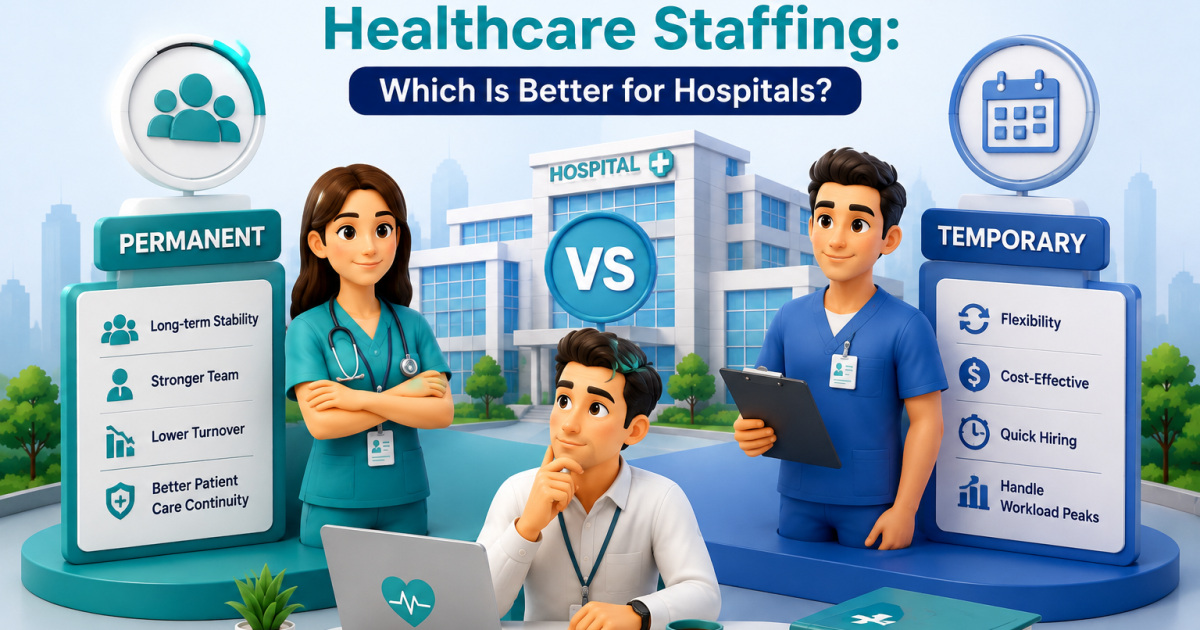
Permanent vs Temporary Healthcare Staffing: Which Is Better for Hospitals?
There is no single answer to which staffing model is better. It depends on what the hospital needs at that time. Permanent staffing is usually a better fit for long-term roles, while temporary staffing can help when the hospital needs people quickly or only for a limited period.
Permanent staffing may be better when:
- The hospital expects the position to be needed for a long time
- Patient demand is steady
- The role is important to the hospital’s daily operations
- The department needs consistent staff for patient care
- The hospital wants to build and develop its own team over time
Temporary staffing may be better when:
- A position needs to be filled quickly
- The staffing need is only for a short period
- Patient numbers change from season to season
- Current staff need extra support during busy periods
- The hospital needs a specialist for a specific or limited requirement
In the end, permanent vs temporary healthcare staffing should be decided based on the hospital’s actual workforce needs. Cost and hiring speed matter, but factors such as patient demand, role requirements, staffing urgency, and long-term workforce plans also play an important part.
When Should Hospitals Choose Permanent Healthcare Staffing?
-
For Long-Term Clinical Roles
Positions that need to be filled every month of every year, such as ward nurses or lab technicians, generally make more sense permanently than through repeated temporary contracts.
-
For Core Hospital Departments
Departments like emergency care, ICU, and general medicine tend to need a stable core team that understands the hospital’s protocols and patient population without repeated re-training.
-
When Continuity of Care Is a Priority
Patients often benefit when the same clinical team follows their case over time. A stable team can track a patient’s history, spot changes early, and coordinate care more smoothly than a rotating group of temporary staff.
-
When Hospitals Want to Build Long-Term Talent
Permanent hiring opens the door to structured training, leadership development, and internal promotion, which helps hospitals build a pipeline of future department heads and senior clinicians rather than starting from scratch each time a leadership role opens.
When Should Hospitals Choose Temporary Healthcare Staffing?
-
To Fill Urgent Healthcare Vacancies
When a role can’t sit open through a multi-week recruitment process, temporary staffing offers a faster route to getting a qualified professional in place.
-
During Seasonal Demand
Flu season, monsoon-related illness spikes, and other periods of increased patient volume often call for extra hands without adding permanent headcount.
-
To Cover Staff Leave or Unexpected Absences
Common examples include maternity leave, extended medical leave, sudden resignation, and illness-related absence. Temporary staff keep the department running while the hospital plans its next step.
-
For Specialized Short-Term Requirements
Sometimes a hospital needs a specific skill set, such as a particular surgical specialty, for a limited period. Temporary staffing lets the hospital access that expertise without committing to a full-time position.
What About Temporary-to-Permanent Healthcare Staffing?
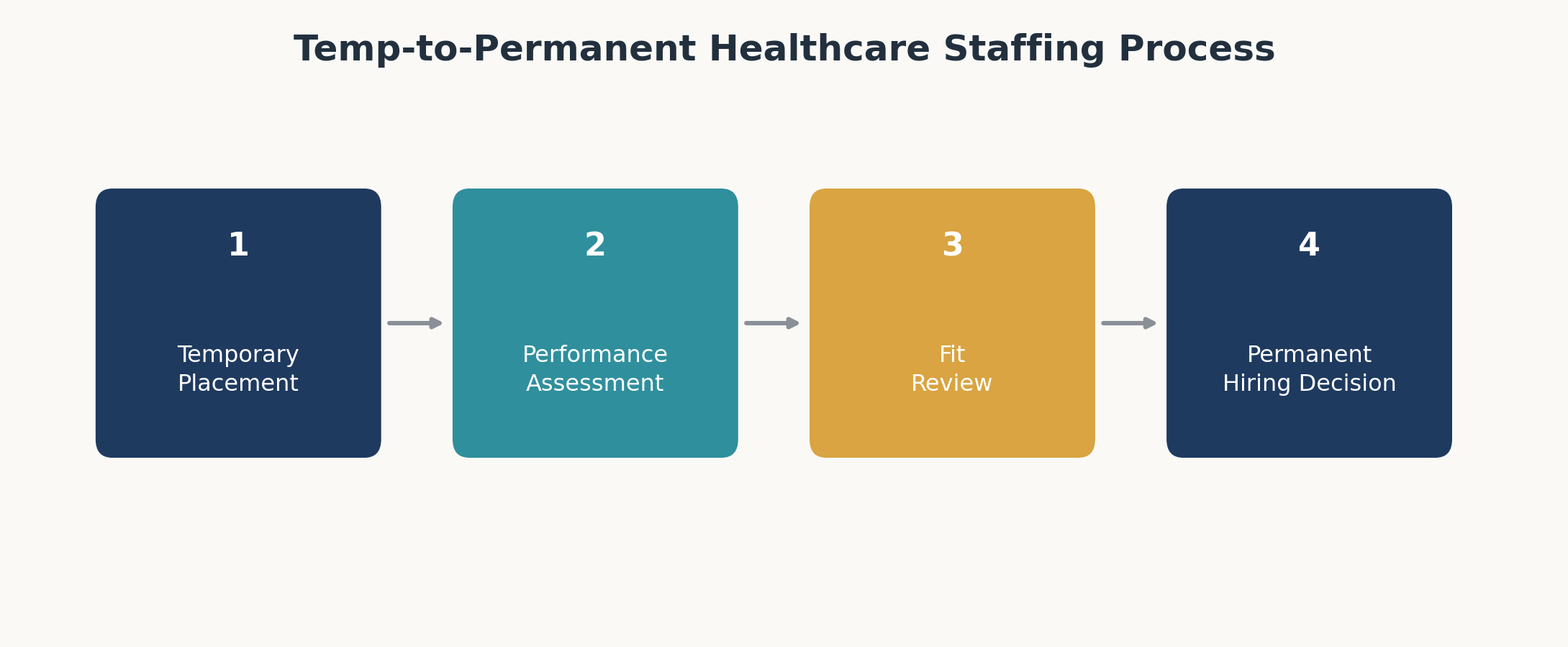
Temporary-to-permanent staffing sits between the two models above. A hospital brings someone in temporarily, evaluates how they perform on the job, and offers permanent employment if the fit works.
The process generally follows:
temporary placement → performance assessment → cultural and role fit review → permanent hiring decision.
Benefits of Temporary-to-Permanent Staffing
- Allows hospitals to evaluate real, on-the-job performance
- Reduces the uncertainty that comes with hiring from a resume alone
- Provides immediate staffing support while the evaluation happens
- Creates a clear pathway toward permanent employment for strong performers
When Should Hospitals Consider This Model?
This approach fits well when a hospital is unsure whether a role will remain necessary long-term, or when it wants a real trial period before making a permanent commitment.
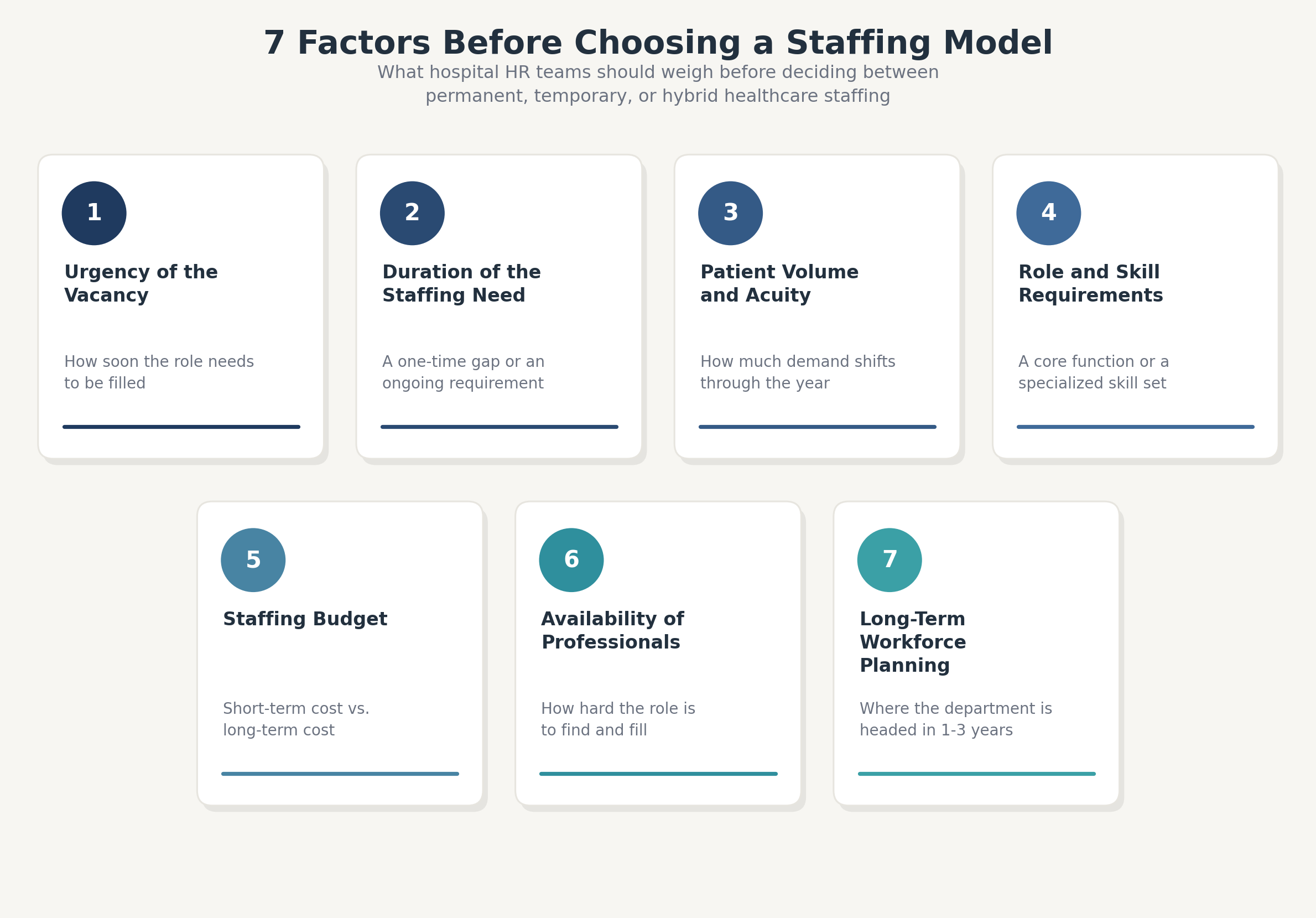
7 Factors Hospitals Should Consider Before Choosing a Staffing Model
1. Urgency of the Vacancy
How quickly does the role need to be filled? A same-week need points toward temporary staffing; a role with a longer runway allows for a full permanent search.
2. Duration of the Staffing Need
Is this a one-time gap or an ongoing requirement? Short gaps favor temporary staff; recurring need points toward a permanent hire.
3. Patient Volume and Acuity
Does patient demand for this role fluctuate through the year, or does it stay roughly constant?
4. Role and Skill Requirements
Is the position a core function the hospital always needs, or a specialized short-term requirement?
5. Staffing Budget
Weigh the immediate cost of temporary placement against the longer-term cost of a permanent hire, including training and benefits.
6. Availability of Qualified Healthcare Professionals
Some specialties are harder to find than others. A tight talent pool can shape which staffing model is realistic.
7. Long-Term Workforce Planning
Connect the immediate vacancy to where the department expects to be in one to three years, rather than treating each hire in isolation.
Permanent vs Temporary Staffing by Healthcare Role
| Healthcare Role | Potentially Better Model | Why |
| Staff nurses | Permanent / Hybrid | Consistent workforce demand |
| Travel or contract nurses | Temporary | Short-term or location-based needs |
| Physicians | Permanent / Temporary | Depends on specialty and demand |
| Specialists | Temporary / Permanent | Depends on availability and requirement |
| Allied healthcare professionals | Both | Depends on department requirements |
| Hospital administrators | Permanent | Usually long-term organizational roles |
| Seasonal healthcare workers | Temporary | Demand can fluctuate |
These are general patterns rather than fixed rules; the right model for a specific role still depends on the hospital’s own situation.
Common Mistakes Hospitals Make When Choosing a Staffing Model
-
Choosing Based Only on Cost
The cheapest option on paper doesn’t always represent the true workforce impact once training, turnover, and continuity are factored in.
-
Using Temporary Staff for Every Vacancy
Temporary staffing should solve a specific workforce need, not replace long-term planning for roles that are clearly ongoing.
-
Hiring Permanent Staff for Short-Term Demand
Bringing on a permanent employee for a need that turns out to be temporary can create workforce commitments the hospital didn’t need to make.
-
Ignoring Candidate Quality and Credentials
Speed matters, but it shouldn’t come before proper screening and credential verification, especially in clinical roles.
-
Failing to Plan for Future Workforce Needs
Hospitals that only react once a vacancy appears tend to scramble. Planning for upcoming demand keeps staffing decisions ahead of the problem instead of behind it.
How to Choose the Right Healthcare Staffing Model
Choose permanent staffing when: the role is long-term, demand is stable, and the hospital has an ongoing workforce requirement.
Choose temporary staffing when: the vacancy is urgent, the requirement is short-term, and demand fluctuates.
Choose temp-to-permanent when: the hospital has an immediate staffing need alongside a potential long-term requirement, and wants to evaluate candidate fit before committing.
Choose a hybrid approach when: the hospital needs a stable core workforce alongside the flexibility to handle unpredictable staffing requirements.
Frequently Asked Questions
1. Is temporary healthcare staffing more expensive than permanent staffing?
It depends on the timeframe. Temporary staffing can carry higher short-term costs per hire, but permanent staffing carries its own long-term costs, including training, benefits, and retention efforts. The better comparison looks at total cost over the length of the need, not just the rate per shift or contract.
2. How quickly can hospitals hire temporary healthcare professionals?
Turnaround varies by role and specialty, but temporary placements through a staffing provider are generally much faster than a full permanent recruitment cycle, since candidates have often already been screened and verified in advance.
3. Can temporary healthcare staff become permanent employees?
Yes. This is exactly what the temp-to-permanent model is built for. A hospital can evaluate a temporary hire’s performance and fit before offering a permanent role.
4. How do hospitals maintain quality when using temporary healthcare workers?
Quality depends on proper screening, credential verification, and clear onboarding, even for short-term roles. Working with a reliable staffing provider that verifies licenses and experience helps maintain consistent care standards.
5. What should hospitals check before hiring temporary healthcare professionals?
Key checks include valid licensing and certifications, relevant clinical experience, references, and a clear understanding of the specific skills the role requires.
Conclusion
Permanent staffing gives hospitals stability and helps build strong teams over time, while temporary staffing provides flexibility when vacancies are urgent or staffing needs change.
Temporary-to-permanent staffing offers another option for hospitals that want to assess a professional before making a long-term hiring decision.
There is no single staffing model that works for every hospital. The right choice depends on factors such as the urgency of the role, patient demand, budget, staffing duration, and long-term workforce plans.
Staffton Health helps hospitals connect with pre-screened and credential-verified healthcare professionals for different staffing needs. Whether a hospital needs permanent staff, temporary coverage, or a potential long-term hire, Staffton Health helps make the recruitment process easier and more efficient.