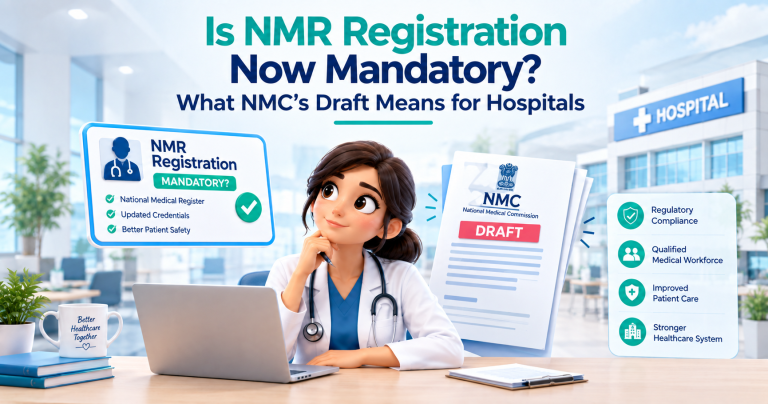


The National Medical Commission (NMC) has proposed a centrally generated unique identification number for every registered medical practitioner.
Under the draft, the number would link each doctor to the National Medical Register (NMR) and allow practice in any state without fresh registration.
For hospital HR teams, that touches credential checks, onboarding files and multi-city hiring. The proposal is still a draft, so current state-level requirements continue to apply.
This guide explains the doctor UID in India, how it connects to the Indian Medical Register, what to prepare now, and what could change for hospitals hiring doctors across cities.
Key Points
- The draft proposes one centrally generated UID per registered doctor.
- The UID would follow registration with a state medical council.
- It would give NMR registration and eligibility to practise across India.
- Doctors already on state registers or the Indian Medical Register would get a one-time update route.
- The rules are not final, so hospitals should prepare without changing policy yet.
What the Draft Says About the Doctor UID in India
India has 13,88,185 registered allopathic doctors, according to a written Rajya Sabha reply from Union Health Minister J P Nadda on 2 December 2025. The proposed UID is meant for every registered medical practitioner, so the change would reach a very large pool of clinicians.
The UID would come from the NMC’s Ethics and Medical Registration Board (EMRB).
According to a PTI report carried by Business Standard, the number would grant registration in the NMR and eligibility to practise medicine anywhere in India, without a fresh registration or licence.
The report also states that the UID would be generated after registration in a state medical register.
The number would carry the state or Union Territory code along with the registration number from the state register. For HR teams, that detail matters.
The UID would stay connected to the state record, so a doctor’s original registration would still be the starting point for verification.
The NMC UID Process Step by Step (Draft Version)
The NMC UID process in the draft follows a simple order:
- A doctor registers with a State Medical Council.
- The EMRB generates the UID centrally after that registration.
- The UID grants registration in the NMR and eligibility to practise across India.
- Doctors already listed in the Indian Medical Register or a state register, but without a UID, can do a one-time exercise to update their details on the EMRB portal and obtain one.
Since the text is a draft, the order and wording may change before notification. Hospitals should treat these steps as a direction of travel, not a compliance checklist.
Draft Status: What Is Not Final Yet
The proposal has not become binding regulation. The final text may differ from the current draft. Until a final notification appears, hospitals must keep following the registration rules that apply in each state where they operate.
That has a practical consequence. Offer letters, credential files and joining checklists should not assume that one national number replaces state-level checks. The sensible approach is to prepare fields and processes now, then switch them on when the final text is published.
Get regulatory alerts: Enter your email to receive a short note when the NMC finalises or changes the doctor UID rules. Hospital HR teams and doctors can both sign up. [Email field] [Subscribe button]
How the NMR Unique Identification Number Fits Existing Records
A doctor’s hospital file could soon hold three separate identifiers. HR should keep them distinct:
- State registration number: issued by the state medical council, and the base record.
- NMR unique identification number: the central UID, built from the state or Union territory code and the state registration number.
- Licence validity details: the dates and conditions tied to the right to practise.
Separate fields help reconciliation when a doctor moves between states or when records are updated.
The existing walkthrough on NMR registration online covers the portal side for individual doctors. This article stays on what the UID means for employers.
Why One Nation, One Registration for Doctors Matters to Hospitals
The idea is often summed up as one nation, one registration for doctors: a single identity that travels with the practitioner instead of a fresh state registration for each move. For hospitals, the practical upside under the draft includes:
- Shorter paperwork when a doctor joins a unit in another state, since the central number would already cover practice across India.
- A wider candidate pool for each vacancy, because relocation would not trigger a new state registration.
- Easier transfers between units of one hospital group in different states.
- Simpler planning for visiting consultants who cover more than one city.
These gains depend on the final text and on how the portal works in practice. Interstate medical practice in India would still involve hospital-level credentialing, privileges and employment contracts. The UID removes one administrative step, not every check.
What Changes for Hiring Across Cities
Hospital groups that hire in several cities handle registration paperwork repeatedly. Staffton Health covers doctor hiring in Bengaluru, Pune, Mumbai, Delhi, Chennai, Hyderabad, Kolkata, Ahmedabad and Indore, so the draft maps directly onto a multi-city model. If it is finalised in its current form, the effects would sit in a few places:
| Hiring stage | What could change under the draft |
| Sourcing | A requisition in Pune could draw candidates registered in other states without waiting for a fresh registration. |
| Credential check | HR verifies the state registration and the matching UID record in the NMR. |
| Joining timeline | Registration paperwork may no longer sit between offer and start date for out-of-state doctors. |
| Internal transfers | A doctor moving between a Mumbai unit and a Hyderabad unit would keep the same UID. |
| Visiting cover | Consultant rosters spanning two or three cities become easier to plan. |
What stays the same: interviews, reference checks, clinical privileging and state-level requirements until a final notification.
Multi-city requisitions, including those for doctor and nurse jobs across India, would need one credential format instead of several state-specific ones.
What Hospital HR Can Do Before the Rules Are Final
- Keep state verification in place. Continue confirming each doctor’s state registration and primary council. Reliable doctor verification checks remain the base layer, whatever the final rules say.
- Add UID fields to the credential file. Create fields for state registration number, state or Union territory code, NMR UID, and licence validity date. Leave the UID field optional until the final notification.
- Update offer-letter language. Make the appointment subject to valid registration in the state of posting and, once applicable, a valid UID.
- Plan for the one-time update. If the draft is notified, doctors already on state registers or the Indian Medical Register may need to update details on the EMRB portal. Prepare a short staff notice and a tracker.
- Review the recruitment workflow. Mark the stages of your hospital recruitment process where registration is checked, and note which ones could shorten.
- Assign an owner for tracking. One person in HR or medical administration should monitor the final notification and brief department heads.
What the UID Would Not Solve
A national number identifies a doctor and links records. It does not confirm clinical skill, specialty fit or hospital privileges. Each hospital still interviews, checks references and decides scope of practice.
HR teams should also avoid treating the UID as the only verification step, since data entry errors and mismatched records can still occur.
How Staffton Health Supports Multi-City Doctor Hiring
Hospitals planning to hire doctors in more than one city can discuss their requirements with Staffton Health. The team supports hospitals with doctor hiring across multiple cities, helping them prepare for registration changes and streamline their recruitment processes.
Share the cities, specialties, and joining timelines you need, and the team can review options with you.
Talk to Staffton Health about multi-city doctor hiring
Not ready to discuss hiring? Subscribe to the regulatory alerts above.
FAQs
1. What is the NMC UID for doctors?
It is a proposed centrally generated number for every registered medical practitioner. Under the draft, it follows state registration and gives NMR registration plus eligibility to practise across India.
2. Is the doctor UID India proposal in force?
No. It is a draft. Hospitals should keep following current state registration requirements and watch for the final notification.
3. Will doctors still register with a state medical council?
Under the draft, yes. The UID is generated after registration in a state medical register, so the state council remains the first step.
4. Do existing doctors need to apply again?
The draft proposes a one-time exercise for doctors already in the Indian Medical Register or a state register without a UID. They would update details on the EMRB portal and obtain one.
5. What should hospital HR do now?
Keep verifying state registration, add UID fields to credential files, update offer-letter wording, and assign someone to track the final notification.
Conclusion
The proposed NMC UID could simplify interstate medical practice in India by tying a central number to a doctor’s state registration and the NMR. For hospital HR, the useful response is preparation: keep state checks, add UID fields, and watch for the final notification.
Hospitals that hire in several cities stand to gain most if the draft is finalised, since one credential logic would apply across locations.