
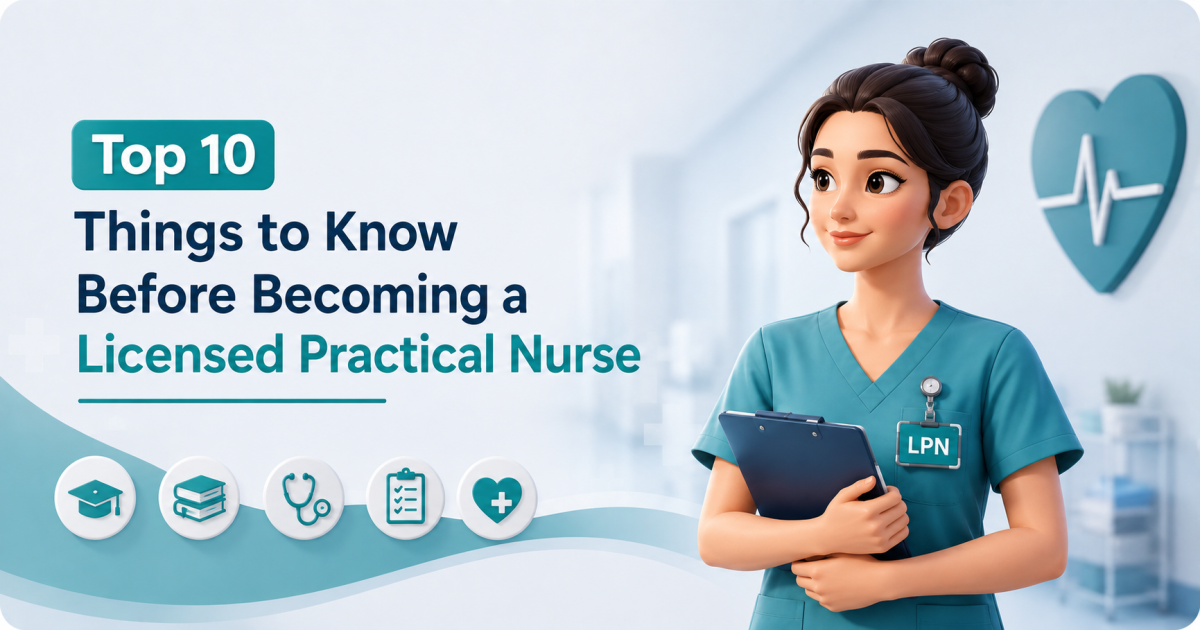
A licensed practical nurse provides hands-on care that helps patients feel safe and supported during treatment and recovery.
If you are thinking about becoming a licensed practical nurse, it is important to understand the education, licensing, daily duties, skills, and work environment involved before choosing this career.
The U.S. Bureau of Labour Statistics projects about 54,400 job openings for licensed practical and licensed vocational nurses each year from 2024 to 2034.
The field also has steady job opportunities. This guide helps you to know what are the top 10 things you should know before becoming a licensed practical nurse.
Who Is a Licensed Practical Nurse?
A licensed practical nurse is a trained caregiver who works under the supervision of a registered nurse or physician, handling basic medical care like checking vitals, giving certain medications, and assisting with daily patient needs.
Their scope varies by state, but the focus stays on direct, consistent hands-on patient support. LPNs may work in hospitals, nursing homes, clinics, rehabilitation centers, and home care.
10 Things to Know Before Becoming a Licensed Practical Nurse
Before enrolling in a program, it helps to understand what the job actually involves, how long training takes, what the exam covers, and where a licensed practical nurse can work once certified.
1. LPNs Provide Direct, Hands-On Patient Care
A licensed practical nurse spends most of their shift working directly with patients rather than behind a desk. They check vital signs, help with medications where state law permits, and assist with everyday needs like bathing, feeding, and mobility.
Working under an RN or physician’s supervision, LPNs are often the first to notice small changes in a patient’s condition, which makes them the true frontline of daily care. (65 words)
- Monitor vital signs, administer basic medications
- Work under supervision of RNs/physicians
- Serve as the frontline of daily patient care
2. Demand for LPNs Is Growing Fast
The job market for licensed practical nurses is expanding quickly, and the numbers back it up. Current BLS projections point to steady openings each year, driven largely by an aging population that needs more consistent long-term care.
Chronic conditions like diabetes and heart disease are also pushing demand higher across nearly every state, giving new LPNs strong job security no matter where they choose to work.
- Cite current BLS/industry growth projections.
- Aging population driving long-term demand
- Strong job security across regions
3. Becoming a Licensed Practical Nurse Takes Less Time Than an RN Degree
One of the biggest draws of becoming a licensed practical nurse is speed. Most programs run between 12 and 18 months, compared to the two to four years needed for an RN degree. Tuition costs are also considerably lower, which means less debt and a quicker return on investment.
For anyone eager to start earning in healthcare without a long wait, this shorter path makes practical nursing an appealing choice.
- Typical program length (12 to 18 months)
- Lower tuition cost vs. RN/BSN routes
- Faster entry into paid employment
4. Programs Combine Classroom Learning With Clinical Practice
LPN training is not just lectures and textbooks. Coursework covers anatomy, pharmacology, and nursing fundamentals, but the real learning happens once students step into clinical settings.
Supervised rotations give them exposure to actual patients and real medical situations, while hands-on skills labs let them practice procedures safely before facing them on the job. This mix of theory and practice is what prepares graduates to work confidently from day one.
- Anatomy, pharmacology, and nursing fundamentals coursework
- Supervised clinical rotations
- Hands-on skills labs
5. You’ll Need to Pass the NCLEX-PN Licensing Exam
Finishing a training program is only half the journey. Every licensed practical nurse must pass the NCLEX-PN exam, which tests clinical judgment, patient safety, and core nursing knowledge through a computer-adaptive format.
Each state board sets its own licensing requirements alongside this exam, so it’s worth checking local rules early. Once licensed, LPNs must also complete continuing education to keep their credentials current and stay sharp in practice.
- Exam format and what it tests
- State/board licensing requirements
- Continuing education for license renewal
6. LPNs Work in a Wide Range of Healthcare Settings
Part of what makes this career flexible is the sheer variety of places that hire licensed practical nurses. Hospitals and clinics need them for routine patient care, while long-term care facilities and nursing homes depend on LPNs as a core part of daily staffing.
Home healthcare and hospice settings also rely heavily on practical nurses, giving graduates the freedom to choose an environment that fits their personality and pace.
- Hospitals and clinics
- Long-term care and nursing homes
- Home healthcare and hospice
7. There Are Multiple Specialization Paths
A licensed practical nurse is not locked into one type of work. Many pursue certifications in pediatrics, geriatrics, or IV therapy to build deeper expertise in a specific area. Others focus on long-term care or rehabilitation settings, where steady patient relationships matter most.
Choosing a specialty does more than sharpen skills. It also makes a resume stand out, often opening doors to better pay and stronger job offers.
- Pediatrics, geriatrics, IV therapy certifications
- Long-term care and rehabilitation focus
- How specializing boosts employability
8. Salary Expectations for Licensed Practical Nurses
Pay is naturally one of the first questions anyone asks before becoming a licensed practical nurse. National averages give a solid baseline, but actual earnings shift depending on the state, the type of facility, and years of experience.
LPNs working in skilled nursing facilities or government roles tend to earn more than those in physicians’ offices. Overtime shifts and night differentials can also push take-home pay noticeably higher.
- National average salary range
- Factors affecting pay (state, setting, experience)
- Overtime/shift differential potential
9. An LPN Career Can Be a Stepping Stone
For many people, becoming a licensed practical nurse is just the starting point rather than the final destination. LPN-to-RN bridge programs let practical nurses build on their existing training instead of starting over from scratch.
Many schools also accept credit transfers, which shortens the time needed to earn a full RN degree later. This makes the LPN path a smart, low-risk way to test a nursing career before committing further.
- LPN-to-RN bridge programs
- Credit transfer opportunities
- Long-term career growth paths
10. The Role Demands Emotional Resilience and Compassion
Technical skills matter, but they are only part of what makes a great licensed practical nurse. The job can be physically tiring and emotionally heavy, especially when working with patients facing serious illness or end-of-life care. Patience and clear communication go a long way in these moments.
In many ways, soft skills like empathy and calm under pressure matter just as much as clinical training itself.
- Physically and emotionally demanding work
- Importance of patience and communication skills
- Why soft skills matter as much as clinical skills
Conclusion: Is Becoming a Licensed Practical Nurse Right for You?
Becoming a licensed practical nurse is a smart, quick way to start a healthcare career.
The training does not take long, jobs are easy to find, and you get to help people every day. Once you finish your program and pass the NCLEX-PN, the next step is finding the right job.
That is where Staffton Health can help. It connects licensed practical nurses with hospitals that are hiring, so you spend less time job hunting and more time doing the work you trained for.
FAQs
1. How long does it take to become a licensed practical nurse?
Most practical nursing programs take approx between 12 to 18 months to finish. This includes classroom lessons in subjects like anatomy and pharmacology, along with hands-on clinical training. Once you complete the program, you still need to pass the NCLEX-PN exam before you can start working as an LPN.
2. What is the difference between an LPN and an RN?
An LPN provides basic patient care like checking vitals and giving certain medications, working under the supervision of a registered nurse or doctor. An RN has more training, usually a two- to four-year degree, and can take on greater responsibility, including creating care plans and supervising other nursing staff.
3. Is becoming a licensed practical nurse worth it in 2026?
Yes, it is a solid choice right now. Hospitals and care facilities are short on staff, so demand for LPNs is high across most states. The training is shorter and cheaper than an RN degree, which means you can start earning sooner while still working in a meaningful, stable career.
4. Can an LPN become an RN later?
Yes, many LPNs go on to become RNs through bridge programs designed specifically for this path. These programs often give credit for your existing LPN training, which shortens the time needed to finish an RN degree. It is a common and practical way to grow your nursing career over time.
5. What is the NCLEX-PN?
The NCLEX-PN is the licensing exam that practical nursing graduates take to demonstrate that they are ready to provide safe patient care. After completing an approved practical nursing program, candidates must meet their jurisdiction’s requirements and pass the exam to obtain practical nursing licensure.