
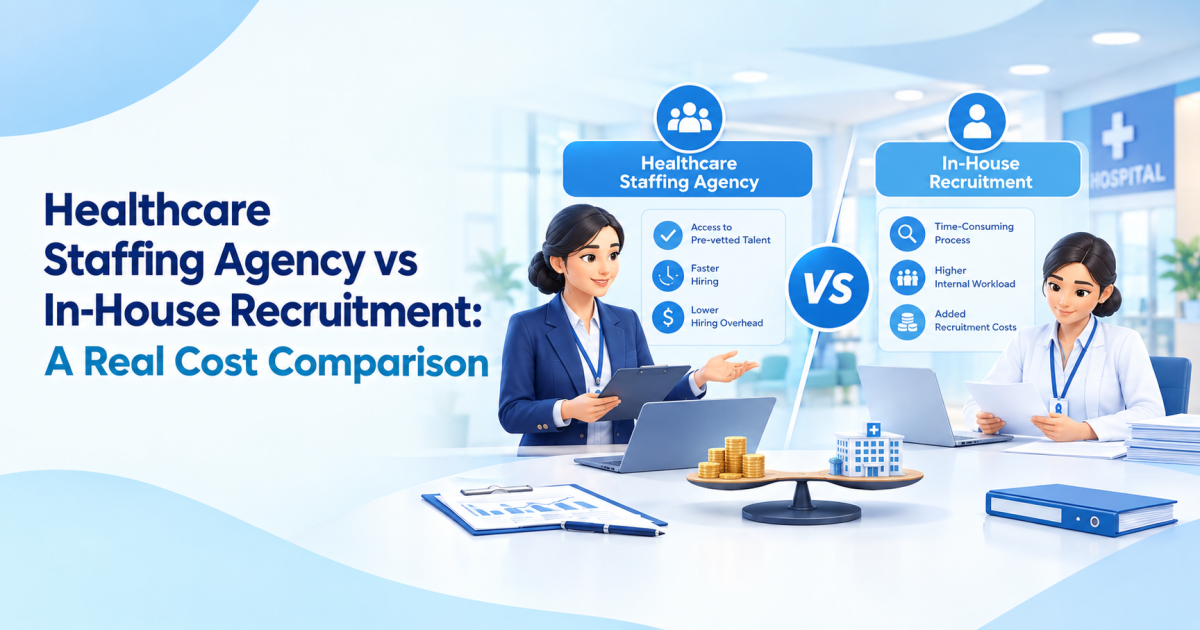
Every hospital that hires regularly faces the same budget question: is it cheaper to pay a medical staffing agency or to build an in-house recruitment team?
The question carries more weight now because skilled people are harder to find. ManpowerGroup’s 2026 Talent Shortage Survey reports that 82% of employers in India are struggling to find the skilled talent they need, and clinical roles sit at the difficult end of that market.
Most comparison articles are written by agencies. This guide compares both models side by side, counts the costs each one hides, and states plainly where an in-house team is the better choice.
What You Are Comparing: Agency Hiring vs In-House Hiring
- Healthcare staffing agency: an external firm sources, screens and shortlists candidates for your open roles. It usually charges a fee linked to the hire’s annual CTC, paid only when someone joins.
- In-house recruitment team: your own HR recruiters source, screen, verify and close candidates. You pay salaries, job portal subscriptions and software costs whether you hire one person or fifty.
Most hospitals already use both. The real goal is to decide which roles go to a medical staffing agency and which stay with your own team, so each vacancy is filled on time at the lowest total cost.
Healthcare Staffing Agency vs In-House Recruitment: Comparison Table
| Factor | Healthcare staffing agency | In-house recruitment team |
| How you pay | Fee per successful hire, usually linked to the hire’s annual CTC | Fixed costs: recruiter salaries, job portals, software |
| What drives cost per hire | The salary of each hire; senior roles cost more to place | Hiring volume; cost per hire falls as volume rises |
| Cost when nobody is hired | Usually nothing | Full fixed cost still paid |
| Time to fill: common roles | Depends on whether the agency already holds candidates | Fast when referrals and college tie-ups are active |
| Time to fill: rare specialists | Usually faster, thanks to wider networks | Often slow, because the internal network is limited |
| Candidate quality control | Shared; agency screens first, you confirm | Full control over screening and fit |
| Credential verification | Agency checks first, but you should still verify | Entirely your team’s responsibility |
| Confidential hiring | Strong; searches can run without public ads | Difficult to keep quiet internally |
| Culture fit | Weaker; the agency knows your hospital less | Stronger; recruiters know your wards and teams |
| Main risks | Fee disputes, duplicate submissions, early exits after the replacement window, vendor dependence | Recruiter resignation, verification skipped under pressure, long vacancies for niche roles |
| Where it wins | Rare specialists, urgent or confidential hires, tier-2/3 locations, low hiring volume | Steady high-volume roles like staff nurses, GDAs and ward technicians; internal promotions; referrals |
Cost Per Hire: Fixed Team Costs vs Agency Fees That Track Salary
In-house cost is mostly fixed. A recruiter’s salary, your job portal plans and your applicant tracking software cost the same in a slow month and a busy one. That means in-house cost per hire falls as hiring volume rises and climbs sharply when volume is low.
A medical staffing agency works the other way. The fee is your contract percentage multiplied by the annual CTC of each hire, so a senior consultant costs far more to place than a staff nurse.
You pay nothing when nobody joins, which suits hospitals that hire only a few people a year.
Whichever side you calculate, include overtime cover, induction and early exits, because these hidden lines often go uncounted in true recruitment cost.
Time to Fill: Where Each Side Gains or Loses Days
An in-house team moves quickly when it has a warm pipeline: staff referrals, nursing college tie-ups and past applicants. It slows down for scarce specialties where nobody in its network is looking for a move.
An agency is fast when it already holds candidates in that speciality and slow when it starts a fresh search. Either way, panel availability, notice periods, and offer approvals stay inside your hospital and often decide the real joining date.
Risk: What Commonly Goes Wrong on Each Side
Agency risks: the same candidate is submitted by two agencies, which leads to fee disputes; an early exit happens just after the replacement window closes; the hospital becomes dependent on one vendor for critical roles.
In-house risks: a key recruiter resigns and the pipeline leaves too; verification gets skipped under pressure; niche roles stay open while the team chases volume.
Hidden Costs Each Model Leaves Out of the Quote
Agency invoices look clear but rarely show the full cost. Clinical heads still spend hours interviewing, HR still repeats some document checks, and an early exit sends you back to the start.
In-house costs hide elsewhere. Recruiter salaries sit in the HR budget, but overtime covering empty posts sits in the ward budget, and closed beds show up as lost revenue. Leave these out and in-house hiring looks cheaper than it is.
A fair comparison puts both sets of hidden costs on the same sheet before deciding.
Where In-House Recruitment Genuinely Wins
Agency-written content rarely admits it, but an in-house team is often the cheaper and better choice. It wins when:
- You hire the same roles every month. Staff nurses, general duty assistants and ward technicians are in steady demand. A good recruiter’s fixed salary spreads across many hires, and paying an agency fee on each one adds up fast.
- Internal mobility and referrals work well. Promoting a senior staff nurse to unit in-charge, or hiring through staff referrals, involves no external fee and shortens onboarding.
- You have strong local pipelines. Hospitals with nursing college partnerships or a known local reputation often fill entry-level roles without outside help.
- Fit matters more than reach. For roles that depend on knowing your wards and consultants, people inside the hospital judge fit better.
If your hospital hires similar roles every month and can afford one or two dedicated recruiters, the maths will often favour building in-house capacity for those roles.
Where a Medical Staffing Agency Earns Its Fee
A medical staffing agency is worth the fee when speed, reach or discretion matters more than cost per hire. Typical cases include:
- Rare specialists: intensivists, perfusionists and cath lab technologists, where your own network will not surface enough candidates.
- Confidential replacements: when a department head is being replaced and the search cannot be advertised.
- Tier-2 and tier-3 locations: where the local pool is thin and candidates must relocate.
- Short-term surges: a new wing, a new department launch, or seasonal cover. If the need is temporary, compare permanent vs temporary healthcare staffing before signing a permanent placement contract.
- Very low hiring volume: when a full-time recruiter cannot be justified, paying only on success is practical.
How to Run Your Own Agency vs Internal Hiring Calculation
Use one year of data for both models.
- Annual in-house cost = recruiter salaries + job portal plans + software + share of HR head time + interview hours of clinical heads.
- In-house cost per hire = annual in-house cost ÷ hires closed by your own team.
- Agency cost per hire = contract fee percentage × annual CTC of the hire + internal interview time + any verification you still repeat.
- Add vacancy cost to both = daily cost of the empty post × days taken to fill.
Compare results by role group, not as one hospital-wide average. An agency can be expensive for staff nurses yet cheaper for an intensivist once vacancy days are counted.
To judge staffing partner ROI, ask one question: does the value of vacancy days saved exceed the extra fee for that role?
Try the Staffton Cost-Comparison Calculator for Your Hospital
The calculator below runs these formulas for you. Enter monthly hiring volume by role group, average CTC, recruiter costs and agency fee terms.
The results screen compares cost per hire, time to fill and vacancy cost for agency and in-house hiring. To unlock it, share your work email and bed count so the comparison is scaled to your hospital’s size.
Questions to Ask Before You Sign a Staffing Agency Contract
If some roles will go to an agency, get these answers in writing:
- Is the fee based on annual CTC, a flat amount or a monthly retainer, and how is GST applied?
- How long is the replacement window?
- Who owns a candidate if two agencies submit the same profile?
- What is verified before a profile reaches you?
- What are the exit terms if service drops?
Hospitals that evaluate medical staffing solutions against written answers like these avoid most fee disputes later.
FAQs
1. Is a medical staffing agency cheaper than in-house recruitment?
It depends on volume and role type. For steady, high-volume roles, an in-house team is usually cheaper because fixed costs spread across many hires. For rare specialists or low volume, an agency can cost less once vacancy days are counted.
2. How do healthcare recruitment agencies charge their commission?
Most agencies charge a percentage of the hire’s annual CTC, payable after joining. Some charge a flat fee or monthly retainer. Confirm GST, payment terms and replacement conditions in the contract.
3. What does an in-house recruiter cost a hospital?
The full cost of an in-house recruiter includes salary, job portal plans, software and clinical heads’ interview time. Divide the yearly total by hires closed to get a fair cost per hire.
4. When should a hospital outsource staffing?
Outsource when roles are rare, urgent, confidential or based in locations with a thin local talent pool. Keep steady, repeatable hiring in-house if you have the recruiters to handle it.
5. How do I measure the ROI of a staffing partner?
Compare the value of vacancy days saved with the extra fee paid for each role. Track time to fill, early exits and offer acceptance by channel every quarter.
Conclusion:
There is no single winner in the healthcare staffing agency vs in-house recruitment debate. In-house teams win on steady, high-volume roles. A medical staffing agency earns its fee on rare, urgent, and confidential searches. Most hospitals get the best result by splitting roles between the two.
Run the numbers by role group, include vacancy cost on both sides, and review the split every quarter. When comparing the best medical staffing companies, start with your own numbers and a clear view of which roles need outside help.
Staffton Health helps hospitals with the roles that need outside support. Hospitals can review pre-verified doctors, nurses and allied health professionals, talk to candidates directly, and work with the Staffton team for structured hiring.
Ready to see which roles your hospital should outsource? Talk to the Staffton team about your open roles and hiring volume.