
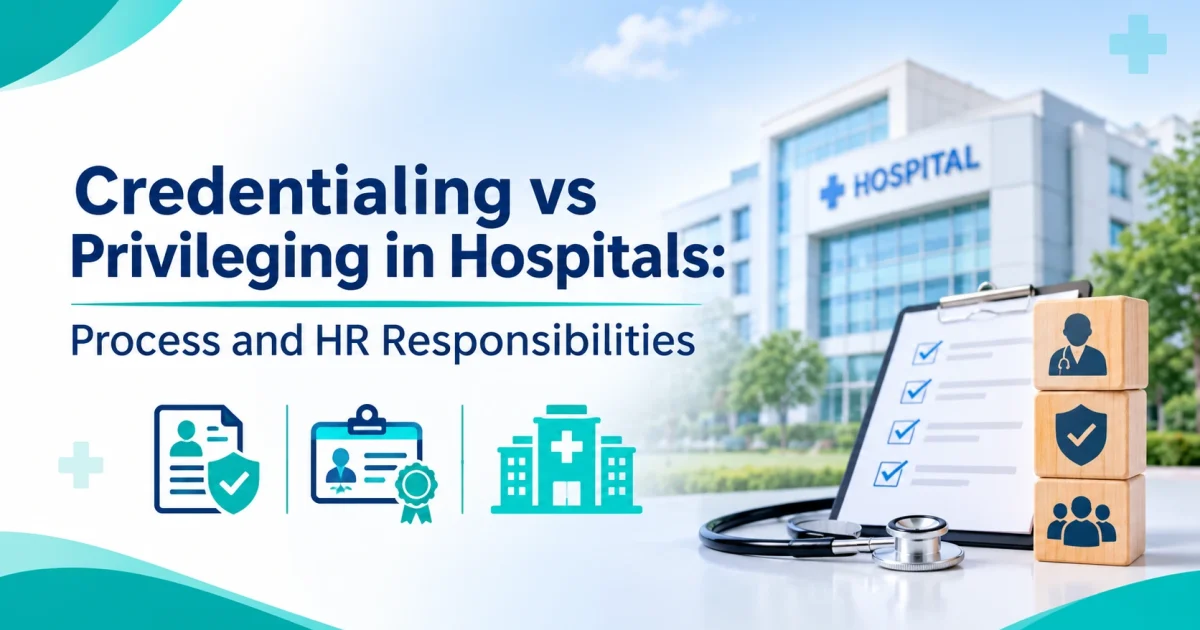
Credentialing vs privileging in hospitals sounds like paperwork jargon, yet the two steps answer different questions. Credentialing asks whether a clinician is qualified. Privileging asks what that clinician may do inside your hospital.
A doctor can pass the first and still be denied part of the second.
Hospital HR teams sit in the middle of both. This guide gives a short definition of each, a side-by-side table, the process in six steps, a sample privileging matrix for a mid-size hospital and a plain split of HR duties.
Credentialing vs Privileging in Hospitals
Credentialing is the verification of a clinician’s qualifications, registration and work history.
Privileging is the hospital’s written permission for that clinician to perform defined procedures and services. Credentialing comes first, and privileges should never rest on an unverified file.
| Key Point | Credentialing | Privileging |
| Core question | Is this clinician qualified to practise? | What may this clinician do in this hospital? |
| What is checked | Registration, degrees, experience, indemnity cover, professional record | Training in the procedure, logged cases, peer input, hospital equipment and backup |
| Scope | General; the same checks for every doctor | Specific to the person, the specialty and the facility |
| Owner | HR and the medical staff office | Credentials committee or medical director, with management approval |
| Output | A verified file | A written list of approved procedures and areas |
| Timing | Before the offer or joining | Before the first independent case |
| Review | When registration or indemnity renews, or the record changes | On the interval set in hospital bylaws, or when scope changes |
| If it fails | The candidate does not proceed | The doctor works with limits or under supervision |
What Is Medical Staff Credentialing?
Medical staff credentialing is a fact check on the person. The hospital confirms that the clinician is who the papers say, holds the qualification claimed and is entitled to practise. For doctor credentialing in India, a typical file covers:
- Registration number, council and name matched to the register
- Degree and postgraduate certificates matched to the specialty applied for
- Employment history confirmed with previous employers
- Indemnity cover details
- Any disciplinary or complaint history, disclosed by the candidate and checked
Credentialing is not a one-time event. Registration and indemnity cover expire, and a clinician’s record can change after joining, so the file needs a renewal date for every item, not only a start date.
Each item should be confirmed with the issuing body, never from a photocopy alone. Hospitals can run the register lookup through doctor verification against national and state records.
What Is Privileging? Scope of Practice and Privileging Criteria
Privileging sets the scope of practice in a hospital: which procedures, units and patient groups a clinician may handle without supervision. Privileging criteria in a hospital usually fall into four groups:
- Training: postgraduate or fellowship training in the procedure
- Experience: a logged list of cases done independently
- Peer input: references and the department head’s opinion
- Hospital capability: equipment, staff and backup in place
The last group is easy to forget. A surgeon trained in a procedure still cannot be privileged for it where the hospital has no theatre set-up or ICU support for it.
Privileges attach to the person, not the title. Two consultants with the same designation can hold different lists.
Visiting consultants who practise across hospitals receive privileges from each hospital separately, and the appointment path for a consultant doctor in a private hospital shows how this plays out.
The Clinical Privileging Process in Six Steps
- Collect. HR gathers the application, certificates, experience letters, indemnity details and a case list.
- Verify. Each item is confirmed with the issuing body. This is where employee background verification for hospitals applies, whether done in-house or through a partner.
- Review. The credentials committee checks the file for gaps and mismatches. Credentialing ends here.
- Request and assess. The doctor requests specific privileges. The department head and committee compare each request with training, logged cases and hospital capability.
- Approve in writing. The medical director or committee approves, management signs off and the doctor receives a written privilege list.
- Monitor and renew. Early cases are reviewed, and privileges are re-examined on the bylaw interval, or sooner when the doctor adds a procedure, changes role or returns from long leave.
Time is the usual pressure point. A StatPearls review of provider profiling from the US National Library of Medicine describes an initial application checklist of 20 to 30 items that commonly takes 60 to 90 days to complete and verify.
That figure comes from US medical staff offices, so Indian hospitals should time their own files before promising start dates.
Who Owns What: HR, Committee and Medical Director
Unclear ownership is the most common reason files stall. A workable split looks like this:
- HR or the medical staff office: collects documents, runs verification, tracks expiry dates and keeps the file.
- Department head: confirms that each requested privilege matches the doctor’s training and logged cases.
- Credentials committee: reviews the full file and recommends the privilege list.
- Medical director: gives clinical approval and decides any limit or supervision requirement.
- Management: signs off the final list and owns the hospital’s capability to support each privilege.
HR Responsibilities in Credentialing and Privileging
Clinicians decide scope. HR runs the machinery behind the decision, and the two roles should stay separate: HR must not approve or edit privileges, and the committee should not chase documents. Core HR duties:
- Keep one file per clinician, with a verified-on date against each document.
- Track registration and indemnity expiry dates and flag them before they lapse.
- Share each privilege list with OT, ICU and emergency rosters, so scheduling matches approved scope.
- Trigger re-review when a doctor adds a procedure, changes department or returns after long leave.
- Place credential filing and privilege confirmation in the onboarding checklist for clinical staff.
- Record the date and reason for any limit, suspension or withdrawal.
Common Mistakes in Credentialing and Privileging Files
- Treating the register check like the whole job. Registration confirms a licence, not procedure skill.
- Granting privileges by designation instead of logged work.
- Verifying only on joining day and never on renewal.
- Skipping visiting consultants because they are not on payroll.
- Letting the matrix go stale after new equipment arrives.
- Rostering a doctor before the privilege list is signed.
Hiring That Makes Credentialing Easier
Gaps in a credentialing file often start before the offer. Staffton Health’s hiring platform cross-references doctors and nurses against state medical boards and registry databases, and verifies licensing, certifications, and compliance records before profiles reach a shortlist.
Hospital teams that want a head start on privileging can request the privileging matrix template and fit it to their own departments. Teams planning verified clinical hiring across roles can also contact Staffton through the enquiry page.
Conclusion
Credentialing vs privileging in hospitals is a question of order. Verify the person first, then define the work in writing. Hospitals that keep the two steps separate, tie privileges to logged work and keep HR files current can answer most audit questions from one folder. Start with the matrix, name an owner for each step and set review dates before the next senior hire joins.
Frequently Asked Questions
1. What is the difference between credentialing and privileging?
Credentialing verifies a clinician’s qualifications, registration and record. Privileging lists the procedures and services that clinician may perform in one hospital.
2. Who grants privileges in a hospital?
In most private hospitals, a credentials committee or the medical director’s office reviews requests, and management approves the final list. Hospital bylaws set the exact route.
3. Can a doctor be credentialed but not privileged for a procedure?
Yes. A verified doctor may lack logged cases, training or hospital support for a procedure. The committee can limit, supervise or decline that privilege.
4. How often should privileges be reviewed?
The interval comes from hospital bylaws. Review is also needed when a doctor adds a procedure, changes department or returns after long leave.
5. Do nurses and allied staff need privileging?
Many hospitals use competency sign-off for defined tasks in ICU, OT or dialysis. Scope and format vary by hospital policy.