
A strong onboarding process decides whether a new nurse or technician reaches day 90 or resigns in week three. Hospitals spend weeks on sourcing, screening, and offers, then hand the joiner an ID card and a ward number.
That gap is costly. A 2026 survey of US acute care hospitals found that 29.5 percent of new hires left within their first year. The survey covers US hospitals, so use it for direction and track your own 30-day and 90-day exits.
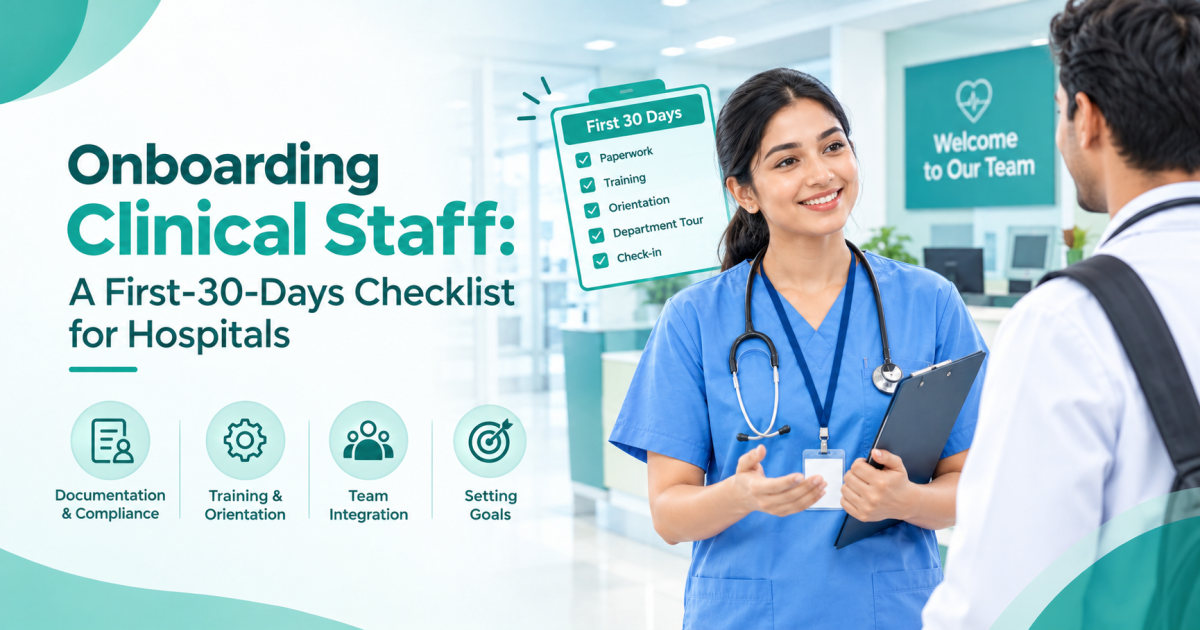
This checklist covers the first month in four stages: before day 1, day 1, week 1, and day 30. It includes credential filing, unit orientation, and preceptor assignment, so HR heads and nursing leaders can run the onboarding process with named owners and fixed deadlines.
Why do new joiners leave in the first month?
Early exits rarely come from one big event. They come from small gaps between the offer and the first weeks:
- A credential file stays open, so system access and the first roster are delayed.
- The unit learns about the joiner on the morning of arrival.
- No preceptor is rostered on the joiner’s shifts, so questions go unanswered.
- Pay, leave, or roster queries have no one assigned to reply.
Each gap is a process failure, not a staff failure.
These gaps also sit well before any of the nurse retention strategies a hospital builds for later years can help, because a nurse who leaves in week three never reaches them.
Assign every task below to one named person before the joining date. HR usually owns documents, payroll, and access. The nurse manager, charge nurse, and preceptor own unit orientation and skills sign-off.
Before day 1: credential filing and unit preparation
Owners: HR and the nurse manager
The onboarding process starts once the offer is accepted, not on the joining date. Use the gap to close the file and prepare the unit.
- Confirm in writing the joining date, reporting time, unit, shift pattern, and reporting person.
- Collect originals and copies of degree and diploma certificates, council registration certificate, experience and relieving letters, identity and address proof, photographs, and any health or vaccination records your policy requires.
- Finish credential filing and verification before the first shift. Pulling a nurse off the floor in week two to fix a file wastes clinical time, and the same principle drives doctor verification for physicians.
- Share the staff nurse job description so duties, shift expectations, and reporting lines match the offer.
- Request HIS or EMR login, biometric entry, email, locker, and uniform.
- Name the preceptor and roster that person on the joiner’s first-week shifts.
- Brief the charge nurse on the arrival date and the joiner’s experience level.
- Send a one-page welcome note with the gate, dress code, first-week roster, and a contact number.
Set one rule: if the credential file is still incomplete three days before joining, HR informs the nurse manager that day.
Day 1: hospital orientation and unit introduction
Owners: HR, IT, charge nurse
Day 1 should leave the joiner calm, not overloaded. Split it into two blocks.
Morning: the hospital orientation program
- Welcome by HR, with ID card, uniform, and locker issued
- Payroll data, bank details, policy acknowledgments, and the salary date explained
- Fire safety, infection control basics, emergency codes, patient rights, and incident reporting
- System login tested with a real login, not a demo
Afternoon: unit orientation
- Unit tour covering the nursing station, medication room, crash cart, equipment store, and exits
- Introduction to the charge nurse, the preceptor, and the doctors on rotation
- Week-one roster handed over in writing
- Ten-minute check-in with the nurse manager before the shift ends
No joiner should leave day 1 without four answers: where to report tomorrow, who to call, who the preceptor is, and when the first salary arrives. Do not assign an independent patient load on day 1.
Week 1: preceptor assignment and supervised practice
Owners: preceptor and nurse manager
A preceptor is an experienced nurse who teaches and observes the joiner on the unit. Pick the preceptor for unit experience and patience, not only seniority, and reduce that nurse’s own patient load during the first week.
Without that relief, the preceptor becomes a source of rushed instructions.
- Roster the joiner and preceptor on the same shifts for the full week.
- Run new joinee clinical training on the unit’s core tasks: medication administration steps, handover format, EMR documentation, escalation chain, and the equipment the unit uses daily.
- Check skills directly with a short competency sheet. A CV is a starting point, not proof of hands-on ability.
- Hold a ten-minute huddle after each shift to cover what went well and what felt unclear.
- Review pay slip data, leave rules, and roster rules with HR by Friday.
- Close the week with a Friday check-in with the nurse manager.
Skills differ by unit. An ICU joiner needs practice with monitors, ventilators, and infusion pumps, while a ward joiner needs a different list.
Build one competency sheet per unit instead of one for the whole hospital.
Weeks 2 to 4: widen responsibility in steps
Owners: preceptor and charge nurse
Increase the load only after the preceptor signs off the earlier step.
- Move from observed tasks to a small patient group under the preceptor’s eye.
- Observe the first independent medication round.
- Introduce evening or night shifts if the roster needs them, with a senior nurse present.
- Review three to five documentation entries with the joiner and correct them with reasons.
- Ask HR to confirm the first salary reached the joiner correctly.
Correction works best when it is specific and private.
Day 30: review and sign-off
Owners: nurse manager and HR
The day-30 meeting closes the first loop of the onboarding process. Keep it short, with the joiner, nurse manager, and preceptor in the room.
- Go through the competency sheet and mark each skill signed off, in progress, or not started.
- Write a plan for days 31 to 90, including gaps and who will help close them.
- Ask the joiner for feedback: what matched the interview, and what did not?
- Confirm HR records are complete: credential file, signed policies, probation dates.
- Log the result in one tracker so patterns across units become visible.
The final stage of any hospital recruitment process is joining, but the process only ends when this sign-off is filed.
Early warning signs that predict an exit
Teams that want to reduce early attrition through onboarding can watch for these signals and act within the week, not at the exit interview:
- Credential file still open after day 7
- Preceptor and joiner rostered on different shifts
- Roster changed after joining without notice
- Salary or leave query left unanswered
- Joiner skips huddles, arrives late repeatedly, or stops asking questions
Track four numbers from your own baseline: exits within 30 days, exits within 90 days, days taken to close the credential file, and the share of joiners with a completed day-30 sign-off.
What to do with day-30 findings after a placement
Onboarding does not end when a placement closes. The day-30 review shows which units absorbed a joiner well, which documents caused delays, and how many new joiners a unit can handle together.
Preceptor capacity and shift coverage set that limit, so planning the next nursing recruitment cycle around it prevents a second wave of joiners from landing on a team that is still teaching the first.
Three questions are worth bringing to your recruitment partner after every placement:
- Which documents or checks delayed this joiner?
- Which unit needs a different candidate profile next time?
- Which roles are coming next, and how many can the unit absorb?
Staffton Health works with hospitals on clinical hiring, and this conversation can continue after a placement. The onboarding checklist template gives HR a consistent format for bringing that feedback to the table.
Conclusion
A hospital cannot control every reason a clinician leaves, but it controls the first month. Name an owner for each task, close credential files before day 1, run unit orientation with a prepared preceptor, and hold a structured day-30 review.
Together, these steps give the onboarding process a shape the joiner can feel.
Get the onboarding checklist template. Contact the Staffton Health team to request the day-1, week-1, and day-30 checklist template, and ask about clinical hiring support for your next requisition.
FAQs
1. What is the onboarding process for clinical staff in a hospital?
It is the sequence from offer acceptance to day-30 sign-off: credential filing, system access, hospital orientation, unit orientation, preceptor-led practice, and a structured review.
2. What should a nurse onboarding checklist include?
It should include the credential file, ID and access, safety and infection control orientation, a unit tour, preceptor assignment, a unit-specific competency sheet, weekly check-ins, and a day-30 review.
3. How long should a hospital orientation program last?
Plan general orientation for the first day or two, then supervised unit practice through day 30. Set the length by role, unit, and the joiner’s experience. An ICU role usually needs more supervised time than a general ward role.
4. Who should own onboarding, HR or the nursing team?
Both, with a clear split. HR owns documents, payroll, and access. The nurse manager, charge nurse, and preceptor own unit orientation and skills sign-off.
5. How can hospitals reduce early attrition through onboarding?
Close credential files before day 1, prepare the unit for the arrival, roster the preceptor on the joiner’s shifts, answer pay and roster queries quickly, and hold a day-30 review.