
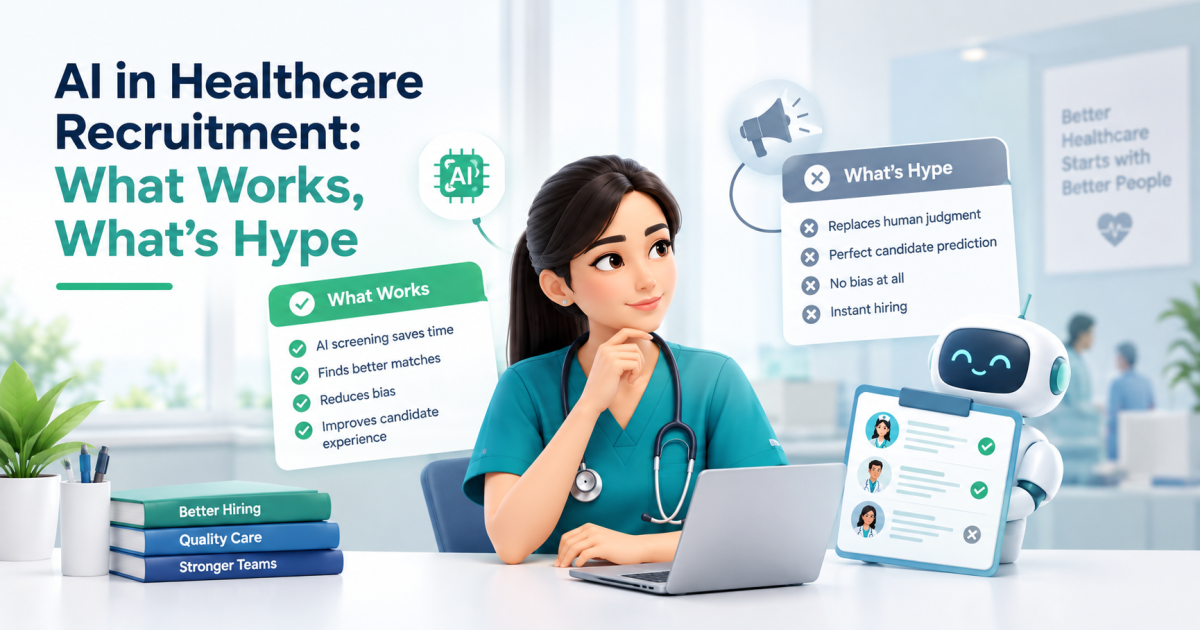
AI in Healthcare Recruitment is easy to oversell and hard to run well inside a hospital hiring office.
According to a report by HIMSS and Medscape, 86% of surveyed respondents said their medical organizations already used AI. However, 72% cited data privacy as a significant risk, highlighting the need for responsible AI adoption.
Most hospitals are still deciding where it belongs, and vendor pages rarely help, because they list every benefit and skip every limit.
This guide sorts hospital hiring tasks into three groups: what to automate, what to supervise, and what to leave with people. It also covers bias and India’s DPDP Act, since both decide whether a tool is safe to use.
One test to sort every AI claim
Ask one question: can a reviewer check the output in under a minute? A registration number matched to a certificate passes. A score that claims to predict whether a nurse will be good with patients does not.
Output that is quick to check can be automated. Output that judges a person needs a human behind it. Everything below follows from that test.
Hand these tasks to AI
-
Document and credential checks
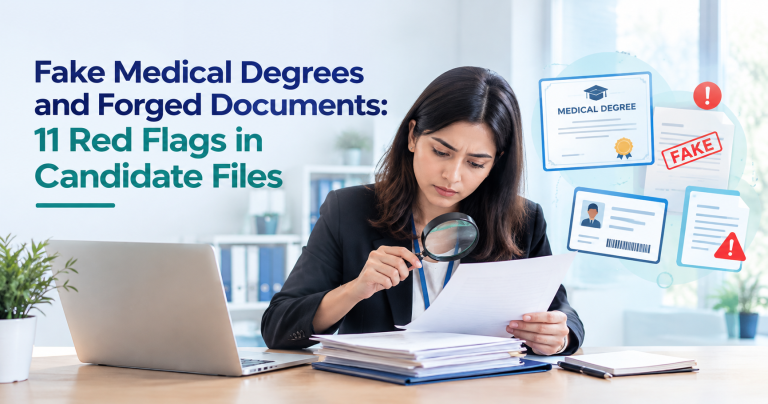
AI credential verification reads the degree, registration certificate, and ID proof, pulls out names, numbers, and dates, and compares them across files.
It flags a registration issued before the degree year, a photo that does not match the ID, or one registration number appearing under two names.
Indian hospitals face this daily because scans are poor, paper formats vary, and forged documents are a known risk. The tool does the first pass, and a reviewer clears the flags. A solid doctor verification process always ends with a human sign-off.
-
Registry and licence lookups
Rules around the national register keep moving. Hospitals tracking NMC registration online need a system that checks current status instead of trusting a certificate that may be years old. Automated lookups and expiry reminders suit this job, since the answer is either right or wrong.
-
Scheduling
Interview slots, reminders, rescheduling and document chasing eat recruiter hours without needing any judgment. Automating them is often the cheapest way to reduce time to hire in healthcare, because delay tends to build up between stages instead of inside them.
Use these, but keep a person watching
1. Candidate chatbots.
Nurses and technicians often apply after a night shift or between duties. They have simple questions about shift timing, location and application status, and a chatbot can answer them any hour of the day.
Two rules apply. Tell candidates it is a bot, and give them a route to a human recruiter. Never let its questions screen anyone out without review.
2. Resume ranking and matching
AI can cut a stack of 400 applications to a shortlist by comparing department experience, licence status, location and shift preference. That is useful, but ranking decides who gets a call.
Clinical leads should write the criteria, and a recruiter should sample low-ranked applications every week to see who the tool is burying.
Keyword rules deserve special care in automated candidate screening for healthcare. An ICU nurse who writes “critical care” instead of “ICU” can vanish from a list with nobody noticing.
3. Job descriptions and candidate messages
AI writes a first draft in seconds. The risk is generic text. A post that reads the same for an ICU nurse and an OT technician attracts neither. A recruiter should edit in the real shift pattern, department, and reporting line before anything goes out.
4. Interview summaries.
Summaries save note-taking time, but they compress tone and hesitation. Treat them as memory aids, not scorecards, and keep the interviewer’s own notes on file.
5. Pipeline analytics
Dashboards showing where candidates drop off can expose a slow stage. One hospital’s data is a small sample, though, so treat patterns as questions, not proof. Set the numbers beside wider healthcare hiring trends before changing a process.
Keep these with people
-
Bedside competence.
No software can tell how a nurse handles a deteriorating patient in the middle of a night shift, or whether a technician stays calm when the OT list runs late.
A tool that scores “clinical fit” from a video answer reads word choice and facial movement, which say little about ward performance. Skills tests, supervised trial shifts and a reference call with a previous charge nurse tell far more.
-
Context behind gaps.
A six-month break could mean maternity leave, caring for a parent, relocation, study, or a bad exit from an employer. A filter sees only empty dates. Rules that penalise gaps quietly remove strong nurses who stepped away for family reasons.
-
Final rejections and offers.
These affect a career and carry legal and ethical weight. A named person should own each one.
Bias, in plain terms
AI learns from past decisions. If a hospital mostly hired from a few colleges, cities or nursing councils in the past, the tool learns that pattern and calls it merit.
Candidates from smaller towns, distance-learning programmes or overseas degrees slide down the list, and no written rule says why. Names, addresses and gaps can also stand in for gender, caste or region.
Three habits reduce the damage. Keep AI out of reject decisions for clinical roles. Compare shortlist rates by gender, region and institution type every quarter, and ask the vendor how the model was tested.
Tell candidates when AI evaluates them, and let a rejected candidate request human review. Transparency costs little, and it protects the hospital’s reputation among nurses, who talk to each other.
A 60-day pilot that starts with verification
Verification is the safest first project, since every output can be checked in under a minute. Pick one role family, such as staff nurses.
In the first two weeks, measure how many days document checks take today across the stages of your hospital recruitment process.
From week three to week six, run AI verification beside the manual check and compare what each one catches. In the last two weeks, review days saved, mismatches found and any candidate complaints. Expand only if the numbers hold.
Staffton‘s verification workflow follows this logic. Candidates upload documents once after a consent notice. AI extracts and cross-checks the details and flags mismatches.
A trained reviewer clears or rejects every flag with notes, and HR receives a verified profile with an audit trail. The workflow does not score bedside skill and never rejects anyone automatically.
FAQs
1. Will AI replace hospital recruiters?
No. It takes over checks and admin work, but judging people, reading context and making final decisions stay with recruiters and clinical leads.
2. Which hiring task should AI handle first?
Credential verification. The output is quick to check, errors are costly, and the time saved is easy to measure.
3. Do candidates need to know when AI is used?
Yes. DPDP expects a clear notice about how their data is processed, and openness about automated tools builds trust with candidates.
4. Can AI resume screening be biased?
It can. Bias creeps in through past hiring data and proxies like names and gaps, so test shortlist rates regularly and keep humans in charge of rejections.
Conclusion
AI in healthcare recruitment hiring pays off when the job is narrow and checkable: documents, registry lookups, and scheduling. It disappoints when asked to judge character, context or clinical instinct.
Hospitals that draw this line early, test for bias, and respect DPDP get the speed without the damage.
If your team still verifies registrations and degrees by hand, begin there.
Book a demo of Staffton’s credential verification workflow and watch a real candidate file move from upload to verified profile.