
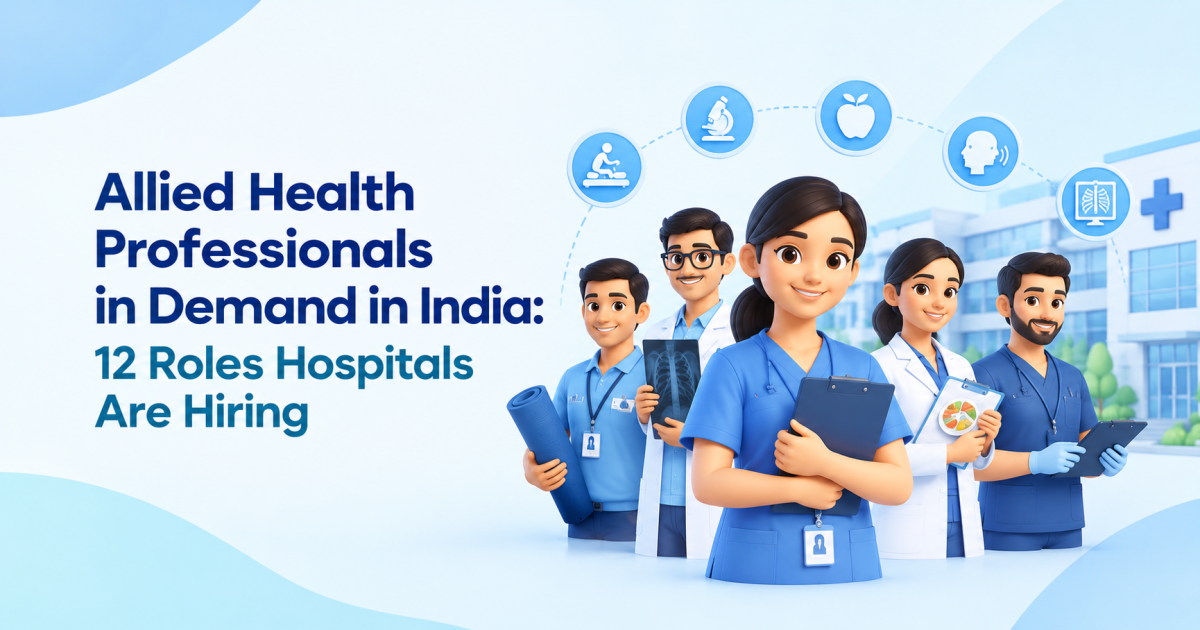
Allied health jobs are clinical and technical roles in hospitals that support diagnosis, treatment and rehabilitation, filled by trained professionals who are not doctors or nurses.
In India, they include laboratory technologists, radiographers, OT and anaesthesia technicians, dialysis technicians, physiotherapists, pharmacists and several other specialised roles.
These professionals run the tests, scans, procedures and records that every hospital service depends on, which is why their vacancies affect daily operations so directly.
The field is also wider than most people assume.
The National Commission for Allied and Healthcare Professions, set up under the NCAHP Act, 2021, is mandated to regulate 56 allied and healthcare professions grouped into 10 categories. No single hospital hires all of them, so this blog narrows the list to 12 roles that multi-speciality hospitals in India rely on every day.
For each role, you get what drives demand, the usual entry qualification, and a relative pay band. HR teams can use it to plan hiring across several roles at once, and students can use it to pick a direction before paying course fees.
What Allied Health Jobs Cover and Why “Paramedical” Still Appears in Job Searches
Allied health professionals are trained clinical and technical staff who help diagnose, treat, rehabilitate and support patients without being doctors or nurses. They run the laboratory, operate imaging machines, prepare theatres, manage ventilators, dispense medicines and keep medical records accurate.
Older hospital notices, course brochures and many job seekers still say “paramedical”, so people search for paramedical jobs in India and allied health jobs as if they were two separate markets.
In practice, both terms point to largely the same pool of roles. Even the regulator gets searched in different ways, with many people typing “NCHP allied health” instead of the full commission name.
For employers, the lesson is simple. Use both terms in job posts, and write job titles the way candidates actually search for them. A “lab technician” post and a “medical laboratory technologist” post can describe the same bench, so mention both.
Most healthcare recruitment attention goes to doctors and nurses, which is exactly why allied posts often get written in a hurry and attract the wrong applicants.
Why Hospitals Keep Reopening the Same Allied Health Vacancies Every Quarter
Three pressures drive allied hiring, and all of them are visible from inside the hospital.
New service lines. A cath lab brings cardiac technologists. An imaging bay brings radiographers. A day-surgery unit brings OT and anaesthesia technicians. Every new machine arrives with a staffing requirement attached.
Round-the-clock rosters. Emergency, ICU, dialysis and laboratory services run through the night. One post on paper becomes several people once leave, weekly offs and rotating shifts are counted.
Skill over certificate. Training programmes differ widely in hands-on exposure, so two candidates with the same diploma can perform very differently on day one. Managers end up screening for practical ability, which takes longer.
Hospitals that fold allied headcount into hospital manpower planning, tied to beds, theatre lists and service hours, stop treating each resignation as a surprise.
Allied Health Professions List: Demand, Qualification and Pay Band in One Table
| Role | Demand signal (what drives it) |
Entry qualification | Pay band |
| Medical laboratory technologist | Very high. Every OPD and inpatient service waits on reports | DMLT or B.Sc in medical laboratory technology | Entry to mid |
| Radiology and imaging technologist | High. X-ray, CT and MRI need operators on rotating shifts | Diploma or B.Sc in radiology and imaging technology | Mid |
| Operation theatre (OT) technician | Very high. Grows with every added theatre or surgery list | Diploma or B.Sc in operation theatre technology | Entry to mid |
| Anaesthesia technician | High. Moves with surgical volume | Diploma or B.Sc in anaesthesia technology | Mid |
| Dialysis technician | High. Repeat patients and long machine hours | Diploma or B.Sc in dialysis technology | Entry to mid |
| Emergency medical technician/paramedic | High. Ambulance and casualty rosters never pause | Diploma or B.Sc in emergency medical technology | Entry to mid |
| Cardiac care technologist | Rising. Cardiology and cath lab programmes add posts | Diploma or B.Sc in cardiac care technology | Mid |
| Respiratory therapist | Rising. Grows with ICU and step-down beds | B.Sc in respiratory therapy | Mid |
| Physiotherapist | High. Rehab after surgery, stroke and long ICU stays | BPT | Mid |
| Hospital pharmacist | High. Dispensing and medication safety run all day | D.Pharm or B.Pharm | Mid |
| Clinical dietitian | Steady. Inpatient diet plans and specialty wards | B.Sc or M.Sc in nutrition and dietetics | Entry to mid |
| Medical records technician | Steady. Coding, files, and discharge paperwork | B.Sc in medical record science, or a graduate with records training | Entry |
The pay band shows a role’s relative position among allied roles, not a rupee figure. Actual pay shifts with the city, hospital type, shift load, and years of experience, so treat the band as a planning starting point.
Employers who need a current salary benchmark for a specific city can request one from Staffton Health.
12 Allied Health Jobs Indian Hospitals Are Hiring For Right Now
The roles fall into three working zones: diagnostics and the front door, procedure rooms and critical care, and recovery, medication and records. Most technician jobs in hospitals in India sit in the first two zones.
1. Medical Laboratory Technologist
Nearly every treatment decision waits on a lab report, which makes this one of the most consistently hired allied roles. Technologists process samples, run analysers and flag abnormal results to clinicians.
Key features
- Works with: blood and tissue samples, biochemistry and haematology analysers
- Shift pattern: day shifts plus night cover for emergency tests
- Screening point: sample handling, analyser familiarity and how errors get reported
Best for: Detail-minded people who prefer bench work to bedside work.
2. Radiology and Imaging Technologist
Radiographers position patients and operate X-ray, CT and MRI equipment, usually on rotating shifts. Each modality needs separate competence, and moving from X-ray to MRI is a genuine step up.
Key features
- Works with: X-ray, CT, MRI and sometimes mammography units
- Shift pattern: rotating, with emergency imaging at night
- Screening point: which machines the candidate has run independently
Best for: People comfortable with technology and short, frequent patient interactions.
3. Operation Theatre (OT) Technician
OT technicians set up theatres, manage instruments and sterility, and support the surgical team through each case. One missing OT technician can push an entire morning list back by hours.
Key features
- Works with: instrument trays, sterile set-ups, theatre equipment
- Shift pattern: early starts plus on-call for emergency surgery
- Screening point: practical instrument set-up and sterility discipline
Best for: Calm team players who like structured, high-focus work.
4. Anaesthesia Technician
Anaesthesia technicians check machines, airway equipment and monitors before every case and assist the anaesthetist during it. This role moves with surgical volume, so plan it in the same requisition as OT technicians.
Key features
- Works with: anaesthesia workstations, airway trolleys, patient monitors
- Shift pattern: theatre hours plus emergency on-call
- Screening point: machine checkout routine and airway equipment knowledge
Best for: Methodical people who enjoy equipment and checklists.
5. Dialysis Technician
Dialysis patients return on fixed schedules, so the unit runs long machine hours week after week. Technicians prime and run machines, monitor patients during sessions and keep strict infection control.
Key features
- Works with: dialysis machines, water treatment checks, session monitoring
- Shift pattern: long day sessions, sometimes evening slots
- Screening point: machine priming, infection-control habits and attendance record
Best for: Dependable people who like building rapport with regular patients.
6. Emergency Medical Technician / Paramedic
EMTs are the first clinical contact for ambulance and casualty arrivals. They assess the patient, give basic life support, and hand over to the emergency team, and these rosters never pause.
Key features
- Works with: ambulances, casualty bays, life-support equipment
- Shift pattern: 24×7 rotation
- Screening point: scenario-based life support and clean handover habits
Best for: Quick thinkers who stay steady under pressure and enjoy physical work.
7. Cardiac Care Technologist
Cardiac technologists handle ECGs, echo support, treadmill tests and cath lab assistance. Hospitals that launch or expand cardiology services need them early, often before patient volumes build.
Key features
- Works with: ECG, TMT, echo machines, cath lab equipment
- Shift pattern: OPD hours plus cath lab on-call
- Screening point: which tests the candidate performs without supervision
Best for: People who want diagnostics mixed with procedure-room work.
8. Respiratory Therapist
Respiratory therapists manage ventilators, oxygen therapy and airway care in ICUs and step-down units. The role grows in importance each time a hospital adds critical-care beds.
Key features
- Works with: ventilators, oxygen delivery systems, airway devices
- Shift pattern: ICU rotation including nights
- Screening point: ventilator modes handled and real ICU exposure
Best for: People who enjoy data-heavy bedside work.
9. Physiotherapist
Physiotherapists rebuild movement after orthopaedic surgery, stroke, cardiac events and long ICU stays. Ward-based and outpatient posts suit different temperaments, so ask candidates which one they want.
Key features
- Works with: inpatient mobilisation, OPD rehab, chest physiotherapy
- Shift pattern: mostly day shifts
- Screening point: specialty exposure such as ortho, neuro or cardio-respiratory
Best for: Patients, encouraging people who like seeing progress over weeks.
10. Hospital Pharmacist
Hospital pharmacists keep medicines moving safely to wards and outpatients all day. The full set of pharmacist roles and responsibilities stretches well past the counter into stock control, expiry tracking and catching prescription errors.
Key features
- Works with: dispensing, inventory systems, medication safety checks
- Shift pattern: day shifts plus night cover for inpatient pharmacy
- Screening point: prescription-checking accuracy and comfort with stock software
Best for: Precise people who like clinical knowledge mixed with operations.
11. Clinical Dietitian
Clinical dietitians design diet plans for inpatients with diabetes, kidney disease, post-surgical needs, and similar conditions. They work closely with doctors, nurses and the hospital kitchen.
Key features
- Works with: nutrition assessments, therapeutic diets, discharge counselling
- Shift pattern: day shifts
- Screening point: hospital internship exposure and counselling skills
Best for: People who enjoy combining science with patient conversations.
12. Medical Records Technician
Records technicians keep files, coding and discharge paperwork accurate and retrievable. Hospitals tend to undervalue this role until an audit, insurance query or billing dispute arrives.
Key features
- Works with: clinical coding, discharge summaries, hospital information systems
- Shift pattern: day shifts
- Screening point: coding accuracy and software comfort
Best for: Organised people who prefer desk work without direct patient care.
Nursing runs on its own hiring track, even though the same HR desk often handles it. A clear staff nurse job description stops nursing duties from blurring into allied ones, and the licensed practical nurse role needs similar care, since support-level clinical duties are where overlaps usually begin.
Five Practical Fixes for Slow Technician Hiring in Indian Hospitals
Allied vacancies drag for predictable reasons. These fixes cost little and work for any of the twelve roles.
- Write the post around equipment and procedures. “Technician” alone attracts everyone. “CT and MRI operator, rotating shifts” attracts the right people.
- Add a short practical task. Twenty minutes of instrument set-up for OT, sample handling for the lab, or machine priming for dialysis reveals more than a long conversation. Candidates who prepare with sensible interview tips for hospital jobs usually handle these tasks better too.
- Verify certificates and the awarding institute before the offer, not after joining.
- Keep a bench. Hold a shortlist of two or three candidates for each critical role, so a resignation starts a phone call instead of a fresh search.
- Settle shift expectations in the first call. Night and rotating duty is easier to accept when it is stated upfront.
Mapping the hospital recruitment process stage by stage shows where the days actually go, and allied roles lose most of them in verification and notice periods.
Allied Healthcare Careers: How to Choose the Right First Role
Allied healthcare careers are among the most practical healthcare jobs without MBBS, and the right choice depends more on how you like to work than on salary talk.
- Bench and desk work: laboratory, records and dietetics. Predictable hours and less direct patient contact.
- Procedure-room work: OT, anaesthesia, dialysis and cardiac care. Sterile, team-based and shift-driven.
- Mobile, patient-facing work: emergency care, physiotherapy and respiratory therapy. Physical, fast and hands-on.
Before paying course fees, ask two questions: does the institute offer real hospital internship hours, and is the programme recognised? Entry points for healthcare jobs for freshers differ by role, and a strong internship often counts for more than a grade sheet when a hospital is choosing between new graduates.
Hiring Several Allied Roles Together Without Staggered Joining Dates
Allied hiring rarely arrives one role at a time. A new surgical unit needs OT technicians, anaesthesia technicians and a pharmacist together. A new diagnostics wing needs laboratory, radiology and records staff. Opening each as a separate vacancy splits HR attention and staggers joining dates, leaving expensive equipment idle while the last post is filled.
A multi-role brief fixes this. List every role, headcount, shift pattern, and target joining date in one document, then source against all of it in parallel. Decide early which posts need permanent staff and which can be covered temporarily.
A sound permanent vs temporary healthcare staffing mix keeps skill-heavy roles like OT and laboratory on permanent contracts and uses temporary cover for leave gaps and peak load.
This is where medical staffing solutions earn their cost, because one partner running the whole brief removes the gaps between separate searches.
Broader healthcare hiring strategies, such as keeping candidate pipelines warm between vacancies, also work far better when allied roles are planned as a set.
Planning to hire across several allied roles?
Share the roles, city, and joining dates with Staffton Health, and the team will return a sourcing and verification plan for the full set.
[Request a multi-role hiring plan]
FAQs
1. What are allied health jobs?
Allied health jobs are clinical and technical roles that support diagnosis, treatment and rehabilitation without being doctor or nursing roles. Laboratory technologists, radiographers, OT technicians, physiotherapists and pharmacists are common examples.
2. Are paramedical jobs in India the same as allied health jobs?
They describe largely the same group of roles. “Paramedical” is the older word and “allied and healthcare” is the current formal one, so job seekers should search both, and employers should use both in postings.
3. Which allied health job suits a fresher?
Laboratory, OT, dialysis and records roles have clear entry paths through a diploma or degree. The better question is whether bench work, procedure-room work or patient-facing work suits the person.
4. What should hospitals check when hiring allied staff?
Check the qualification and the awarding institute, run a short practical task, confirm shift availability and notice period, and keep verified copies of documents on file.
5. Can one staffing partner hire for several allied roles together?
Yes, as long as the brief lists all roles, headcounts and joining dates in one place. Staffton Health handles multi-role allied requirements in a single engagement.
Conclusion
Allied roles get less attention than consultants, yet a hospital’s schedules, reports and recovery times rest on them. Hospitals that plan all twelve roles together, verify early and keep a bench ready fill posts with far less scrambling.
Candidates who match a role to their working style, and check a course before paying for it, start their careers with fewer regrets.
Staffton Health supports both sides, helping employers with verified multi-role hiring plans and helping candidates find the allied role that fits them.