
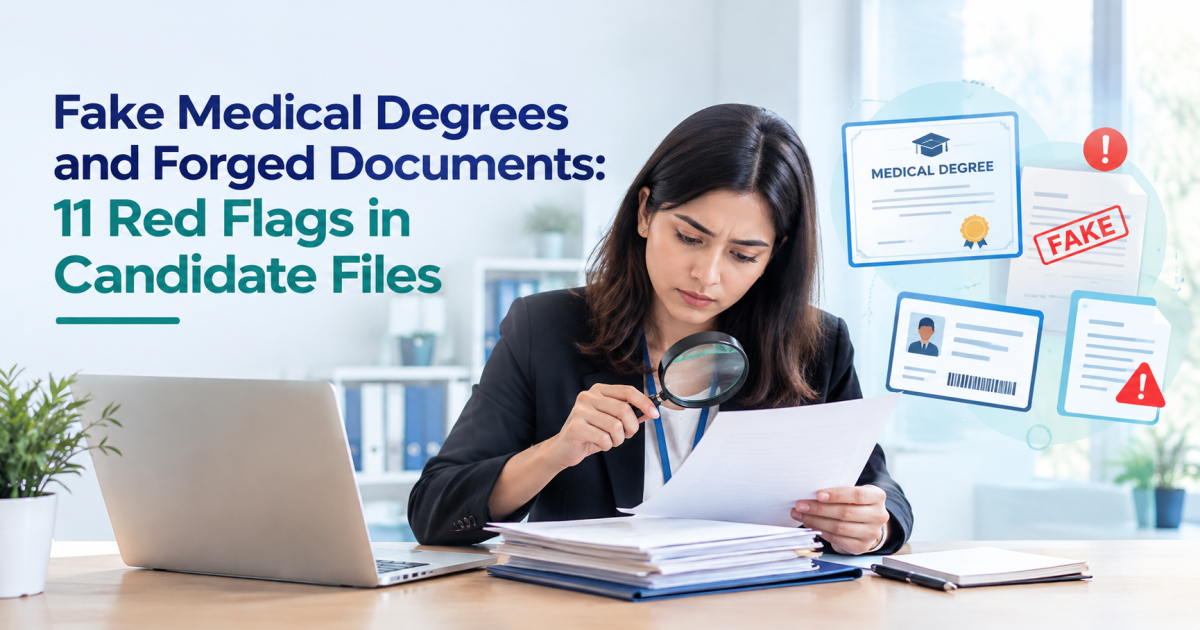
Fake doctors in India are no longer a rare village-clinic story. They are now showing up in government health centres, city hospitals, and internship programmes, often with documents that look completely genuine at first glance.
Here is how serious it has become.
In Rajasthan, the Special Operations Group’s investigation into fake FMG certificates reached 29 arrests by July 2026, including a former Medical Council official, and the gang had allegedly helped 24 foreign-trained doctors practise in India using forged documents.
If a racket can get past a medical council, it can get past a busy hospital HR desk.
This guide gives you 11 concrete red flags to check in every doctor and nurse file, explains the patient-safety and legal risks, and shows you how to verify medical qualifications before an offer letter goes out.
Why Fake Doctors in India Are a Hiring Problem?
Forged credentials enter hospitals through the hiring process. HR teams are the first line of defence, and a weak check can expose patients and the hospital.
1. Patient Safety Is the First Casualty of Credential Fraud in Healthcare
An unqualified person in a clinical role can misdiagnose, prescribe the wrong drug, or mishandle an emergency. These mistakes are often hidden for months because colleagues assume the person was checked. By the time the truth comes out, the harm is done.
- Wrong treatment decisions in ICU, emergency, and OPD settings
- Unsafe procedures by people without supervised training
- Loss of patient trust that is very hard to rebuild
2. Legal and Reputational Exposure Falls on the Hospital Too
Hospitals can face liability for staff they employ. Negligence claims from patients can follow quickly.
- Consumer and medical negligence cases naming the hospital
- Regulatory inspections and accreditation risk
- Negative media coverage that hurts future hiring and admissions
11 Red Flags That Point to Document Fraud in Hospital Hiring
Each red flag below is a specific tell you can check. One flag may be an honest error. Two or more flags in one file need a deeper check before you proceed.
1. The Registration Number Does Not Match the Council’s Format
Every state medical council and the NMC registration should follow their own numbering style. A fake number often looks “right” at a glance but breaks the pattern used by that council, or carries a prefix from a different state.
- Compare the number with the format shown on the council’s official register
- Check the number against the name in the online record, not just its existence
- Watch for numbers that return a different doctor’s name
2. Name, Father’s Name, or Date of Birth Differ Across Documents
Fraudsters often borrow a real doctor’s verification registration and attach their own photo. The giveaway is small mismatches between the degree, marksheets, Aadhaar, and the council record.
- Spelling changes in surname or father’s name
- Different dates of birth on the degree and ID proof
- Initials expanded differently on different documents
3. The Council and University Story Does Not Add Up
A degree from a college in one state with registration in a council that has no record of transfer or NOC is a warning sign. So is a college that was not recognised by the NMC for that course in the admission year.
- Confirm the college was recognised for MBBS or PG in that batch year
- Check that the university named actually affiliated that college
- Ask for the NOC if registration moved from one state council to another
4. The Dates Break Basic Timeline Logic
Date errors are the easiest to spot and the most missed. A genuine MBBS path follows a fixed sequence: admission, course years, internship, then permanent registration. Fake files often get this order wrong.
- Registration date earlier than internship completion
- Degree awarded too soon after the admission year
- PG admission dated before MBBS completion
5. The Internship Completion Certificate Is Missing or Vague
Permanent registration depends on completing the compulsory rotating internship. A missing certificate, or one with no hospital name and dates, suggests the candidate may only hold provisional registration or none at all.
- Ask for the internship certificate with exact start and end dates
- Verify with the issuing hospital, not the phone number on the paper
- Check provisional versus permanent registration status
6. A Foreign Medical Graduate Has No Valid FMGE Proof
Foreign medical graduates must clear the FMGE screening test before practising in India. The Rajasthan case shows forged FMGE certificates are actively sold, so this document needs extra care.
- Verify the FMGE result through the official National Board of Examinations channel
- Match the roll number, session, and name with the result record
- Confirm the registration issued after the FMGE pass date
7. Seals, Fonts, and Signatures Look Inconsistent
Forged documents often show print-level tells. A trained eye can spot them in seconds when comparing with a genuine certificate from the same university.
- Mixed fonts or misaligned text on the same certificate
- Blurry or pixelated seals that look scanned and pasted
- Typos in the university name or Vice Chancellor’s title
8. The QR Code or Verification Link Leads Somewhere Unofficial
Many universities now print QR codes for verification. Forgers copy this feature but point the code to a look-alike website they control. Always check the domain before trusting the result.
- Confirm the link opens the university’s official domain
- Search the university’s verification portal yourself instead of scanning
- Treat any WhatsApp or personal email “verification” as invalid
9. A Forged Nursing Certificate Shows Council Gaps
Nursing fraud follows the same pattern. A forged nursing certificate often comes without valid state nursing council registration, or from an institution not recognised by the Indian Nursing Council for that course.
- Verify registration on the state nursing council portal
- Check renewal status, since many councils require periodic renewal
- Confirm the institution’s recognition for GNM or B.Sc Nursing in that batch
You can compare documents with the role expectations in our staff nurse job description.
10. Work History Is Vague, and References Cannot Be Reached
Fake candidates often list hospitals that have closed, or give references that only have personal mobile numbers. A real doctor usually has a traceable trail of employers, departments, and supervisors.
- Call the hospital’s main HR line, not the number in the CV
- Ask for experience letters on letterhead with designation and dates
- Probe clinical details in the interview that only real experience would show
11. The Candidate Resists Originals or Verification Consent
Genuine candidates rarely object to background checks. Pressure to skip verification, delays in sharing originals, or a rush to join “this week” should slow you down, not speed you up.
- Refuses to sign consent for third-party verification
- Shares only photocopies or phone photos
- Pushes for joining before checks finish
How to Verify Medical Qualification Before You Make an Offer
A simple, repeatable process catches most fraud. The goal is to verify at the source, every time, without slowing down good candidates.
1. Build a Source-Verified Checklist Into Your Recruitment Process
Every check should go to the issuing body, not to the candidate. Add these steps to your hospital recruitment process so no file reaches an offer letter without them.
- Council registration check on the NMC or state council register
- University degree verification through the official portal or registrar
- Internship, FMGE, and experience letters verified directly
2. Keep Verification Fast So You Do Not Lose Good Candidates
Strong checks should not mean slow hiring. Run checks in parallel, start them at shortlisting, and use a verified talent pool where possible.
- Start verification at the shortlist stage, not after the offer
- Use one standard checklist across all departments
- Re-verify registration status at renewal and promotion points
Conclusion: Stop Fake Doctors in India at the Hiring Desk
Fake doctors in India succeed when hospitals trust paper instead of proof. The 11 red flags above give your team concrete tells to look for, from registration number mismatches to timeline errors and nursing council gaps. Checking at the source, every time, protects patients, staff, and the hospital’s name.
This is where Staffton Health helps. Staffton connects hospitals with doctors and nurses whose credentials are verified before they reach you.
Council registration, degree, internship, and experience checks are completed at the source, so your team gets shortlists it can trust and hires faster without cutting corners.
Need help scaling safely? Contact us for hospitals, professionals, or emergency staffing.
FAQs
1. How can I check if a doctor is genuine in India?
Search the doctor’s name and registration number on the NMC’s Indian Medical Register or the relevant state medical council website. Make sure the name, qualification, and council all match the documents the candidate shared.
2. What are the most common signs of a fake doctor certificate in India?
Registration numbers that break the council format, mismatched names or dates, impossible timelines, poor-quality seals, and QR codes pointing to unofficial websites are the most common tells.
3. How do I spot a forged nursing certificate?
Check registration on the state nursing council portal, confirm renewal status, and verify that the nursing institution was recognised by the Indian Nursing Council for that course and batch.
4. Is the hospital legally responsible if it hires a fake doctor?
Hospitals can face negligence claims, regulatory action, and accreditation risk for staff they employ. Proper source verification shows due diligence and lowers this exposure.
5. Should we outsource medical credential verification?
Outsourcing helps when you hire at volume or across states. A specialised partner checks councils, universities, and past employers at the source, which saves HR time and reduces the risk of credential fraud in healthcare.