
A forged degree or a lapsed registration number costs a hospital far more after joining day than before.
Hospital HR teams carry a duty that corporate recruiters rarely face. Every clinical hire handles patients, drugs, and medical records within days of joining. Pre-Employee background verification for hospital hiring is the step that confirms a person is genuine, qualified, and allowed to practise before the first shift begins.
The numbers show why the step matters. In EY India’s 2025 study of more than one million pre-employment screenings, 83% of healthcare candidates with discrepant profiles failed the employment check.
That gap is why employee background verification for hospital teams cannot stop at a resume review.
This guide covers the five checks that matter for clinical roles, the turnaround and consent each one needs, and which tasks a hospital can handle in-house versus with a partner.
Why Clinical Roles Need a Stricter Screening Standard
A nurse, technician, or doctor works with patients from the first shift. Pre-employment screening healthcare teams therefore answer a question a regular HR desk never faces: is this person legally and professionally allowed to do this work?
The answer depends on council registration, a valid qualification, and a work history that holds up under a phone call.
Many hospitals check senior doctors thoroughly and skip junior nurses, ward staff, and technicians. That leaves uneven risk across departments.
Write One Policy Per Role Group
A written employee background check hospital policy removes guesswork and keeps employee background verification for hospital departments consistent. A workable starting point:
- Doctors and nurses: all five checks, plus a reference call for nurses
- Pharmacists and technicians: identity, qualification, registration where it applies, and employment
- Support staff: identity, employment, criminal record, and address
Depth can change by role. The rule should never change by candidate. Applying the same checks to everyone in a role group also protects the hospital from claims of unfair treatment.
The Five Checks for Clinical Roles
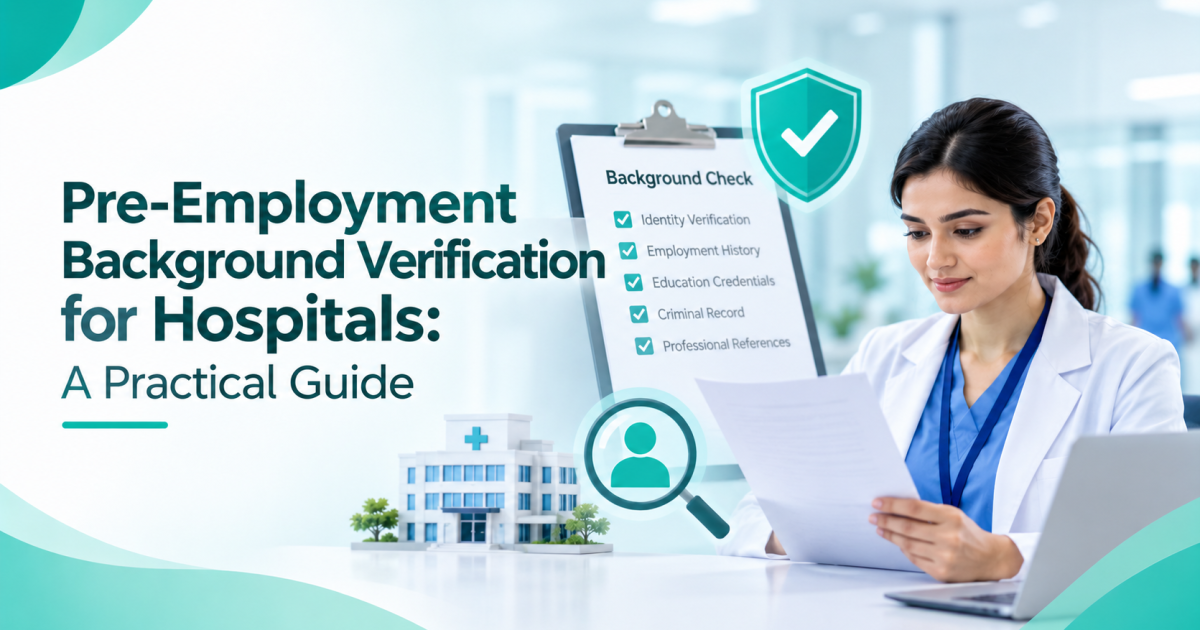
Employee background verification for hospital roles rests on five checks. The table shows what each one confirms, the usual speed, and what the candidate must provide. Turnaround is shown in relative terms because real timelines depend on the state, the institution, and how fast past employers respond. Ask any partner for written timelines per check.
| Check | What it confirms | Turnaround | Consent and documents |
| Identity | Person matches the documents | Fastest of the five, often same day | Signed consent, government photo ID |
| Registration | Legal right to practise | Quick for digital council records, slower for offline ones | Registration number and certificate |
| Qualification | Degree or diploma is genuine and recognised | Usually the slowest, depends on the university | Degree, marksheets, institute details |
| Employment and reference | Tenure, designation, exit status, work conduct | A few working days, depends on past employers | Experience and relieving letters, referee contacts |
| Criminal record | No pending matter that bears on patient safety | A few working days, depends on the court database | Signed consent, address history, parent’s name |
1. Identity Check
Identity comes first because every other check depends on it. Collect a government photo ID and match the name, date of birth, and photograph against the degree and the registration certificate.
Name differences, like initials or a changed surname, slow a file down, so ask for supporting proof early. Where the check allows it, store masked copies of ID numbers.
2. Registration Check
Registration decides whether a person can practise legally. Doctors appear on the state medical council register and the National Medical Register. Nurses appear on the state nursing council register. Confirm the number, name, registration date, current validity, and that the council matches the state of work.
Hospitals that follow a structured nurse registration verification routine can check a digital record in minutes, while older records may need a written request that stretches the timeline.
Doctors go through doctor verification against the medical council record, with the same fields reviewed.
3. Qualification Check
A qualification check goes to the source: the university, the board, or the nursing institute. A scanned degree proves nothing alone.
Tampered marksheets often pass a visual review, which is why forged medical documents need confirmation from the issuing body.
Confirm that the course, year, and institution match the claim, and that the institution holds recognition from the relevant governing body. Start this check early, since it is usually the slowest.
4. Employment and Reference Check
Employment checks confirm designation, tenure, and exit status with recent employers. Use the HR contact from the employer’s official channel, not a number the candidate supplies.
Reference check nurses should go further. Speak with the ward in-charge or nursing superintendent and ask role-specific questions on unit experience, shift reliability, equipment handling, and reason for leaving.
Record the answers in writing. Treat an unexplained gap in work history as a question for the candidate, not a reason to reject.
5. Criminal Record Check
A criminal record check searches court databases using the candidate’s name, address, and parent’s name. Some hospitals add a police verification certificate for roles with patient contact.
The goal is to find pending matters that bear on patient safety. A match is not an automatic rejection. Review how the case relates to the role, share the finding with the candidate, and let them respond before deciding.
Consent Requirements Before Any Check Starts
Consent comes first in any employee background verification for hospital file. No check should start without the candidate’s written permission.
India’s Digital Personal Data Protection Act, 2023 stresses purpose limits, notice, and safe storage of personal data, and universities, councils, and former employers often ask for signed authorisation before they release records.
Background verification companies in India usually capture consent digitally, but the hospital stays responsible for the purpose and the storage. A consent form that holds up in practice covers six points:
- The checks that will run, listed by name
- The team or partner that will run them
- The documents the hospital will collect
- How long the data is stored and who can view it
- The candidate’s right to see a finding and dispute it
- A signature or e-sign with date and time
Collect consent when the conditional offer goes out, not on joining day. Late consent pushes the whole BGV process India timeline into the first week of employment, when the person is already treating patients.
What a Hospital Can Do In-House and What Needs a Partner
Most hospitals handle part of employee background verification for hospital hires in-house. The split depends on where the proof sits. If the proof sits on a public portal, the hospital can check it. If it sits with a university, a court, or another employer, a partner usually reaches it faster.
Work an In-House Team Can Handle
- Collecting consent, documents, and photo IDs in one file
- Matching names, dates, and photographs across documents
- Searching registration numbers on public council portals
- Reference calls to ward in-charges
- Flagging tenure gaps and overlaps
- Keeping the verification log
Work That Needs a Partner
- Direct confirmation from universities and boards
- HR confirmation from many past employers
- Court and police record searches
- Field address verification
- Detection of tampered documents
- Digital consent capture with an audit trail
- Bulk checks during hiring drives
Most background verification companies in India cover the second list. Depth in healthcare councils and institutions varies between providers, so selection needs care.
How to Choose Among Background Verification Companies in India
Price per check is the easiest number to compare and the least useful one when outsourcing employee background verification for hospital hiring. Put these questions to every provider:
- Council coverage: Does it verify state medical and nursing council records, including states with offline registers?
- Turnaround: Is a written timeline given for each check?
- Consent workflow: Does it capture timestamped digital consent in the candidate’s language?
- Report quality: Does the report attach evidence, like a university reply or a portal screenshot?
- Data handling: Where is data stored, who can access it, and when is it deleted?
- Escalation: Is there a named contact for stuck files?
- Subcontracting: Which checks go to third parties?
Run a pilot on a small batch of files before signing a long contract, and compare the reports with in-house lookups on the same candidates. A provider confident in its work will accept that test.
A Clinical Staff Verification Process That Protects Joining Dates
Sequence matters more than speed. A clear order decides how fast employee background verification for hospital hires closes, and quick checks should run first so a failed one stops spend on slower ones.
This order fits most hospitals and sits inside the wider hospital recruitment process:
- Issue a conditional offer with the consent form.
- Run identity and registration checks first. Both are fast and can end the file.
- Start qualification, employment, and reference checks together.
- Run the criminal record check in parallel.
- Review discrepancies with HR and the department head.
- Confirm clearance in writing before releasing the joining date.
Track every check in one shared sheet with a start date, a close date, and a status. That sheet shows where files stall and which check delays joining most.
Handling Discrepancies Without Unfair Rejections
Not every mismatch signals fraud. A spelling difference in a surname, a missing relieving letter from a closed clinic, or a slow university reply is common and fixable. Sort findings into two groups before any decision:
- Correctable: name spelling, date format, missing letters the candidate can replace
- Serious: registration not found, degree denied by the issuing body, employer denying tenure
Share every finding with the candidate in writing, set a fixed window for a reply, and record the final decision with the evidence. Registration validity can also lapse after hiring, so store the renewal date in the staff record and re-check it when due.
Get the BGV Consent and Checklist Pack
Staffton Health is a specialised healthcare recruitment and medical staffing platform in India that connects healthcare professionals with hospitals, clinics, and medical organisations.
The BGV Consent and Checklist Pack supports employee background verification for hospital teams from offer to joining. It includes a consent form template, a role-wise checklist, and a discrepancy log. Hospital HR teams can download it and use it in the next hiring cycle.
Need a quote for verifying clinical hires? Request a verification quote and share your hiring needs with the Staffton Health team.
Conclusion
Pre-employment checks protect patients first and the hospital second. Five checks cover the risk for clinical roles: identity, registration, qualification, employment, and criminal record. Written consent keeps the process lawful and smooth.
In-house teams handle public-portal lookups and reference calls, while a partner handles records held by third parties.
Done well, employee background verification for hospital hiring protects joining dates without cutting a single check.
Hospitals that pick among background verification companies in India on clear timelines, evidence-backed reports, and council coverage lose less time to stuck files. Start with the consent form, build one role-wise policy, and pilot a small batch.
FAQs
1. What are the best background verification companies in India for hospitals?
No single name fits every hospital. Background verification companies in India differ in council coverage, turnaround, and report quality, so compare those three, then pilot a small batch before signing a contract.
2. How long does the BGV process in India usually take?
Identity is the fastest check, and qualification is usually the slowest. Registration, employment, and criminal checks take a few working days each, depending on the council, the past employer, and the court database. Running checks in parallel keeps total time close to the slowest single check.
3. Is consent compulsory for an employee background check hospital policy?
Treat it as compulsory in practice. Written consent supports data protection duties, and third parties often refuse to share records without it.
4. Which checks do nurses need?
All five: identity, registration, qualification, employment, and criminal record. Add a reference call to the last ward in-charge.
5. Should hospitals verify before or after the offer?
Issue a conditional offer, collect consent, run the checks, and release the joining date only after written clearance.