
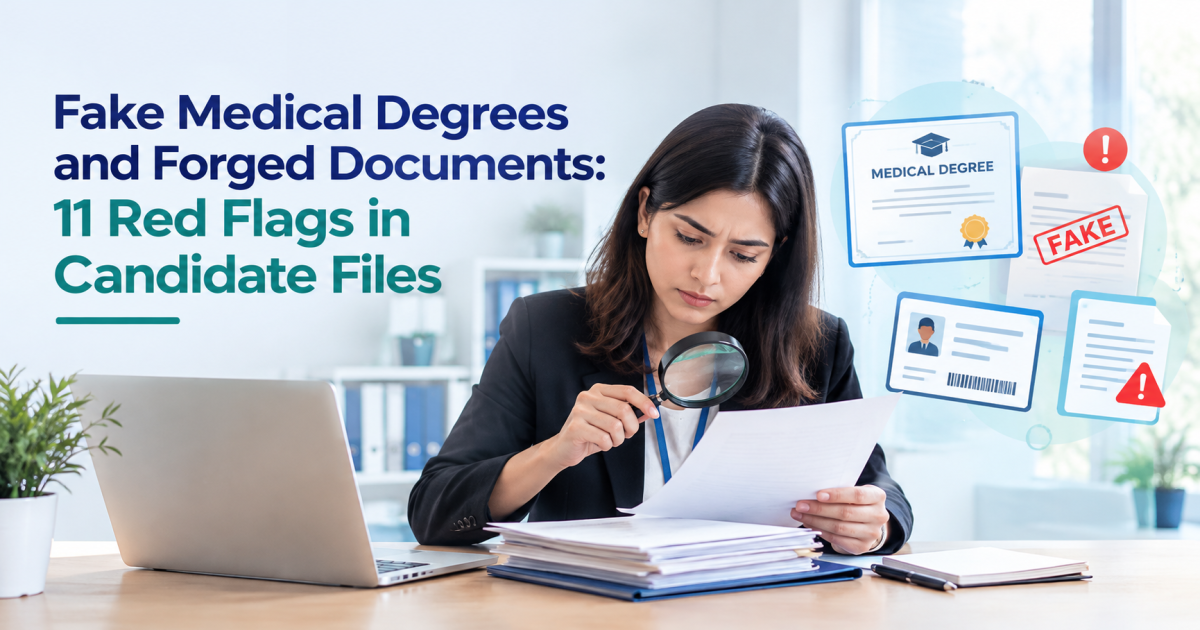
Fake doctors in India are getting past hospital hiring desks with certificates that look genuine on paper.
In Rajasthan, a police probe into forged foreign medical graduate screening certificates has reached 33 arrests, including a former Rajasthan Medical Council registrar, 28 foreign-trained graduates, two council employees, and alleged middlemen.
Police have identified more than 100 suspected beneficiaries, and the forged certificates allegedly sold for Rs 20 lakh to Rs 30 lakh each.
When forged inputs can reach a council record, a clean-looking file is not proof of anything. This guide gives hospital HR teams 11 checks for doctor and nurse files, a table showing where each document should be verified, and the steps to follow when a file fails.
Quick answer: To identify potentially fake doctor credentials, verify the registration number and personal details against the official council record, confirm the candidate’s identity, and cross-check qualification, internship and registration dates.
Always contact issuing authorities through independently verified details rather than relying on contact information printed on candidate documents.
Why Forged Doctor Files Are Harder to Catch in 2026
Recent cases show three patterns that a paper-only review misses.
- Forged screening results. Police in Rajasthan allege that forged FMGE certificates were used to obtain provisional registration and internships. In October 2026, Maharashtra cyber police arrested three people in an interstate racket involving fake FMGE scorecards and certificates.
- Records that were never genuine. Council employees are among those arrested in the Rajasthan case, so a registration number alone does not close the check.
- Borrowed identity. A Delhi Medical Council disciplinary order records a case in which a person admitted practising for about a year under another doctor’s identity, in several places.
The cost of a miss falls on patients first and on the hospital next. An unqualified person in an ICU, emergency or OPD role can misdiagnose, prescribe wrongly or mishandle an emergency.
A Delhi Medical Council registrar has stated that hospitals are held liable for hiring unqualified persons, which puts negligence claims, inspections and accreditation risk on the employer.
Are you a doctor or nurse? Get verified once and reach hospitals hiring in your city.
The 11 Red Flags in One Table
One flag can be a clerical error. Two or more in the same file justify a full source check before any offer.
Registration and Identity Red Flags
1. The Registration Number Does Not Match the Council Record
Registration number formats differ across State Medical Councils, so a number that looks right proves little.
Search it on the council’s own register and confirm that the name, qualification and registration year match the candidate’s papers. A number that returns another doctor’s name, or no record, ends the check.
A missing National Medical Register ID is not a red flag yet. Mandatory NMR registration is still a draft proposal under the 2026 amendment, so the state council record remains the main check.
2. Name, Father’s Name or Date of Birth Changes Between Documents
Compare the degree, marksheets, registration certificate, Aadhaar, and CV line by line. Watch for surnames spelled differently, initials expanded in different ways, and dates of birth that differ by a day or a year. A single mismatch can be a clerical slip. Two or more need a written explanation and confirmation from the issuer.
3. College, University and Council Do Not Connect
Confirm that the college was recognised for the course in the candidate’s admission year and that the named university affiliated it. Registration that moved from one state council to another without a no-objection certificate needs an explanation.
Qualification and Timeline Red Flags
4. Dates Break the Training Sequence
A medical path runs in a fixed order: admission, course years, internship, then permanent registration. Flag a registration dated before internship completion, a degree issued too soon after admission, or a postgraduate admission dated before MBBS completion.
Date errors are the quickest check and the one most often skipped.
5. The Internship Certificate Is Missing, Vague or Unverified
Permanent registration depends on the compulsory rotating internship. Ask for a certificate with the hospital name and exact start and end dates, then confirm it with that hospital’s HR or medical education office using a number you sourced yourself. Record whether the registration is provisional or permanent.
In the Rajasthan case, forged screening results were allegedly used to enter internships. For foreign graduates, an internship certificate does not replace the screening check.
6. A Foreign Medical Graduate Has No Verifiable FMGE Result
Foreign medical graduates must pass the screening test before registration in India. Confirm the result on the National Board of Examinations in Medical Sciences record and match roll number, session, and name, including the spelling on the passport and degree.
Check that registration was issued after the pass date. Treat a scorecard sent by WhatsApp or email as unverified until the record confirms it.
Free checklist for hospital HR:
Get the Doctor and Nurse Credential Verification Checklist with all 11 checks, the issuing body for each document, and a one-page sign-off sheet.
Document Authenticity Red Flags
7. Seals, Fonts or Signatures Look Inconsistent
Compare the document with a genuine certificate from the same university and year. Mixed fonts, pixelated seals, shifted text and typos in the university name or the Vice Chancellor’s title point to editing.
This check catches careless forgeries only. Good forgeries pass visual review, so never clear a file on appearance.
8. The QR Code or Verification Link Points Somewhere Unofficial
Some universities print verification QR codes. Forgers can copy the code and point it to a look-alike site.
Read the domain before trusting any result, and type the university’s verification portal address yourself. Verification by personal email or WhatsApp is not verification.
Nursing, Work History and Behaviour Red Flags
9. A Nursing Certificate Has Registration or Recognition Gaps
Verify registration on the state nursing council portal, check renewal status where the council requires renewal, and confirm the institution was recognised by the Indian Nursing Council for that course and batch.
Online portals add a risk. A Madhya Pradesh nursing council portal test in September 2026 reportedly produced a provisional certificate from fake inputs, and the council said provisional certificates remain subject to verification.
Note whether a certificate is provisional and confirm it with the council before joining. Compare the qualification level with the requirements in the staff nurse job description before shortlisting.
10. Work History Is Vague or Cannot Be Traced
Check that the listed hospitals exist, still operate and had the department named. Call the employer’s main HR line from a number you found independently, not the number in the CV.
Ask for experience letters on letterhead with designation and dates. In the interview, ask clinical questions that only real experience answers, for example handover practice or escalation steps in the candidate’s last unit.
11. The Candidate Resists Originals or Verification Consent
Genuine candidates rarely object to background checks. Treat these as warnings: refusal to sign consent for third-party verification, photocopies or phone photos only, and pressure to join before checks finish.
A rushed joining date is a reason to slow down.
What a Registry Lookup Proves, and What It Does Not
A council or NMC search confirms that a registration exists and what the record says. It does not confirm three things.
- That the candidate is the person on the record. Match a government photo ID to the candidate in person or on a live video call, and compare the signature on the registration certificate with the one on joining papers.
- That the internship or screening result behind the registration was genuine. The arrests of council staff in Rajasthan are the reason issuer checks matter for foreign graduates.
- That the listed experience is real. Only the employer can confirm it.
A Verification Workflow That Keeps Hiring Fast
Place these checks between shortlisting and offer in the hospital recruitment process so no file reaches an offer letter without them. Run them in parallel so good candidates are not left waiting.
| Document | Verify with | Stage |
| Registration certificate | State Medical Council or nursing council register | Shortlist |
| FMGE result (foreign graduates) | NBEMS result record | Shortlist |
| Degree and marksheets | University registrar or official portal | Before offer |
| Internship certificate | Issuing hospital HR or medical education office | Before offer |
| Experience letters | Previous employer HR via an independent number | Before offer |
| Identity | Government photo ID with live match | Before joining |
Four habits keep the process reliable:
- Use one checklist across all departments.
- Store the date, source and name of the verifier in each personnel file.
- Re-check registration validity at renewal, at promotion and during the first month of the onboarding process.
- Use AI-based credential checks to flag format errors and mismatches quickly, and keep the issuer’s confirmation as the deciding step.
A hire removed after joining adds to recruitment cost twice: the vacancy returns and the search restarts.
What to Do When a File Fails a Check
- Pause the offer or joining date. Ask the candidate for originals and a written explanation, since honest errors happen.
- Re-verify with the issuer in writing. Keep copies of every document received.
- Report confirmed forgery. Inform the relevant state medical or nursing council and file a police complaint on legal advice. Have counsel confirm the reporting route in your state.
- Restrict duties if the person already works in the hospital. Hold clinical duties until the check closes, and take legal advice on reviewing the patient records they handled.
Conclusion: Verify the Person and the Paper
Fake doctors in India succeed when hospitals accept paper in place of proof. The 11 red flags above cover registration mismatches, broken timelines, forged FMGE results, nursing council gaps and borrowed identity.
Checking each document with its issuer, and confirming the candidate is the person on the record, protects patients, clinical teams and the hospital’s name.
Staffton Health connects hospitals with doctors and nurses whose council registration, degree, internship and experience records are checked with the issuing bodies before a shortlist is shared.
HR teams receive candidates who have already passed the source checks above, so hiring stays fast without skipping verification. Hospitals comparing partners can review the best medical staffing companies, and doctors and nurses can create a verified profile to be matched with hospitals hiring now.
Hiring doctors or nurses? Get shortlists with source-verified credentials.
FAQs
1. How can a hospital check if a doctor is genuine in India?
Verify the doctor’s registration number through the relevant State Medical Council or official NMC register. Match the name and qualification, confirm identity using photo ID, and verify degrees and internship records with their issuing institutions.
2. How can a hospital verify an FMGE certificate?
Check the candidate’s FMGE result through official NBEMS records. Match the name, roll number and examination session, then confirm registration dates. If the result cannot be verified, pause the hiring process until confirmation.
3. What are the common signs of a fake doctor certificate?
Warning signs include mismatched registration details, inconsistent personal information, impossible training dates, unverifiable internship records, suspicious seals, unofficial QR codes and unconfirmed FMGE results. Investigate discrepancies with the issuing authority before making a hiring decision.
4. Is the NMR unique ID compulsory for doctors in India?
Check the latest National Medical Commission notifications before treating a missing National Medical Register ID as a red flag. Distinguish draft proposals from regulations that have officially come into force.
5. What should a hospital do when it finds a potentially forged certificate?
Pause the hiring decision and contact the issuing authority through independently verified details. Document the findings, request clarification and follow applicable reporting procedures. If the person is employed, seek legal advice before restricting duties.