
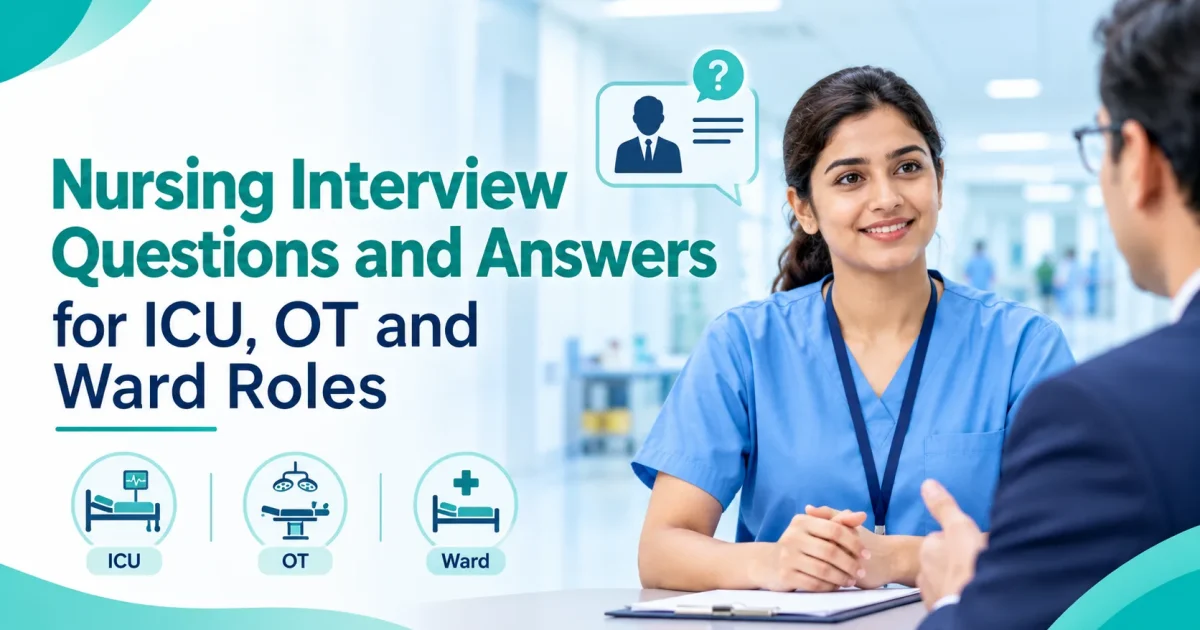
One vague answer about patient safety can end a nursing interview in under a minute. Panels in Indian hospitals rarely stop at “Tell me about yourself.” They test judgment, clinical reasoning, and calm under pressure.
This guide covers 25 nursing interview questions with model answers for ward, ICU and OT roles, plus the clinical scenarios panels favour.
What Hospital Panels Test in Nursing Candidates
India’s nursing workforce continues to grow. According to the Ministry of Health and Family Welfare, 11,09,678 Registered Nurses and Registered Midwives were enrolled in the National Nurses Registration and Tracking System (NRTS) as of 13 July 2026.
With a large registered workforce, candidates must demonstrate clinical knowledge, patient safety awareness, and practical skills to stand out in hospital interviews.
Panels still screen carefully for safe practice, because one clinical error can put a patient’s life at risk.
Most nursing interview questions fall into four groups: clinical knowledge, patient safety, communication and role-specific skills. Many hospitals add a short oral round too. Nursing viva questions for a job usually cover vitals, drug doses, infection control, and emergency steps, so revise those first.
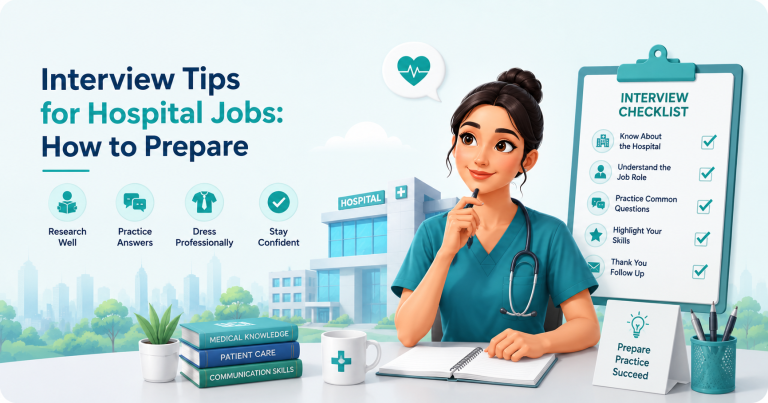
Candidates should also cover the general hospital interview tips, since every panel checks punctuality, grooming, and communication before clinical depth.
Staff Nurse Interview Questions Answers for Ward Roles
Ward panels check fundamentals first. These nursing interview questions reward short, specific, and safe answers.
1. Why did you choose nursing, and why this hospital?
I chose nursing for direct patient care and steady skill growth. Your hospital’s multi-specialty departments and structured training match my goal of building solid ward experience before moving into a specialty.
2. How do you prioritise patients in a busy ward?
I assess airway, breathing, and circulation first, then use vitals and early warning scores to rank risk. Unstable patients get attention first. I delegate routine tasks and update the nurse-in-charge on any change.
3. What are the rights of medication administration?
Right patient, drug, dose, route, time and documentation. Many hospitals add right reason and right response. I check the order, verify allergies, confirm identity with two identifiers and record the dose immediately after giving it.
4. How do you prevent infection on the ward?
I follow hand hygiene at the five moments, use correct PPE, keep aseptic technique during procedures, dispose of sharps safely and segregate biomedical waste by colour code. I isolate patients per hospital policy.
5. What do you do after a needle-stick injury?
I wash the site with soap and running water without squeezing or scrubbing, report to the infection control team and begin post-exposure prophylaxis assessment without delay. I then complete the incident report.
6. How do you handle an angry relative?
I listen without interrupting, acknowledge the concern, explain the care plan in simple words and involve the doctor or nurse-in-charge if the issue is clinical. I stay calm and document the conversation.
7. What does good nursing documentation look like?
It is accurate, timed, signed and objective, and written right after care. I record what I observed and did, not assumptions. Late or missing entries create legal and safety risks.
8. How do you hand over a patient?
I use the SBAR format: situation, background, assessment and recommendation. I include pending investigations, allergies, lines, drains and risks like falls.
ICU Nurse Interview Questions and Model Answers
ICU nurse interview questions go deeper into monitoring, devices and escalation. Panels also expect awareness of ICU staffing norms in India, including why a lower patient load per nurse matters in critical care.
9. What does a GCS score tell you?
The Glasgow Coma Scale rates eye opening, verbal response and motor response, scored from 3 to 15. A falling score signals neurological decline, so I report it immediately and recheck the pupils.
10. How do you reduce ventilator-associated pneumonia?
I keep the head of the bed raised 30 to 45 degrees, give oral care per protocol, review sedation daily with the doctor, maintain cuff pressure, practise hand hygiene and suction only when needed.
11. How do you prevent central line infections?
I follow strict hand hygiene, assist with full barrier precautions during insertion, use chlorhexidine skin preparation, review daily whether the line is still needed, keep dressings clean and scrub the hub before every access.
12. How do you read a basic ABG report?
I check pH first, then PaCO2 for the respiratory component and bicarbonate for the metabolic component. I match the values with the patient’s condition and report abnormal results to the doctor.
13. A ventilator high-pressure alarm sounds. What do you do?
I check the patient first, not the machine. I look for coughing, secretions, biting on the tube, kinked tubing or tube displacement. I suction if needed. If the cause is unclear, I disconnect, bag the patient and call the doctor.
14. How do you prevent pressure injuries in bedridden patients?
I reposition every two hours or per the care plan, use pressure-relieving surfaces, keep skin clean and dry, inspect bony areas daily, support nutrition and document skin condition every shift.
15. How do you support families in the ICU?
I give clear, honest updates within my role, direct clinical questions to the doctor, allow visits per policy and treat their concerns with respect, especially during end-of-life discussions.
Operation Theatre Nurse Interview Questions and Answers
Nursing interview questions for OT roles focus on asepsis, counts and checklists. Precise answers matter more here than long ones.
16. What is the WHO Surgical Safety Checklist?
It has three stages: sign in before anaesthesia, time out before incision and sign out before the patient leaves the theatre. It confirms identity, site, procedure, allergies, equipment and counts.
17. What is the difference between a scrub nurse and a circulating nurse?
The scrub nurse stays sterile, passes instruments and manages the sterile field. The circulating nurse is non-sterile, fetches supplies, handles documentation, helps with positioning and coordinates with the team.
18. How do you maintain a sterile field?
I open packs with correct technique, keep sterile items above waist level, never turn my back to the field, treat anything doubtful as contaminated and replace it, and limit movement and talking.
19. How do you handle a count mismatch?
I stop and inform the surgeon, recount together, check the floor, drapes and waste bins, and request an X-ray if the item is not found. Closure should wait until the count is resolved or the decision is documented.
20. How do you confirm identity and consent before surgery?
I verify name, ID band, procedure, site marking, consent form, fasting status and allergies with both the patient and the file. Any mismatch stops the process until the surgeon clarifies.
Clinical Scenario Questions Panels Favour
The clinical interview questions nurse candidates face often describe a situation and ask for first steps. Use a simple order: assess, act, escalate and document. These scenario-based nursing interview questions also show whether a candidate knows when to call for help.
21. A ward patient’s SpO2 falls to 88 percent. What do you do?
I stay with the patient, sit them upright, check airway and respiratory rate, apply oxygen per protocol, confirm the probe is placed well and repeat vitals. I call the doctor with an SBAR update and follow orders.
22. A post-operative patient has falling blood pressure and a rising pulse. What does this suggest?
It may point to bleeding or fluid loss. I check the dressing and drains, position the patient flat if suitable, confirm IV access, inform the surgeon urgently and prepare for fluids or investigations.
23. You find a patient unresponsive on the ward. What are your first steps?
I check responsiveness and breathing, call for help and the code team, and start CPR if there is no normal breathing or pulse. I send for the defibrillator, compress hard and fast, and note the timings.
24. You realise you gave a wrong dose. What do you do?
I check the patient, inform the doctor and nurse-in-charge immediately, monitor for effects, and file an incident report. I do not hide it, since honesty protects the patient and supports learning.
25. A colleague skips hand hygiene before a procedure. What do you do?
I raise it politely and immediately, because patient safety comes first. If it continues, I report it to the nurse-in-charge or infection control through the proper channel.
Hospital Nurse Interview Preparation Before the Panel Date
1. Keep Documents Ready
Carry registration proof, degree certificates, experience letters and an updated resume. A clean nursing resume format helps the panel scan experience quickly, and nurse registration verification is common before the final offer, so every number and date must match.
2. Revise by Department
Revise vital sign ranges, drug calculations, CPR steps, infection control, and the checklist for the target department. Practise nursing interview questions aloud with a colleague or senior, because oral answers sound different from written notes.
3. Prepare Questions to Ask
Ask about orientation, shift pattern, nurse-patient allocation and growth path. Good questions show that the candidate plans to stay and learn.
-
Get the Interview Prep Ready Openings
Staffton Health has put these questions into a downloadable PDF of nursing interview questions, model answers, and scenario steps for ward, ICU, and OT roles. Candidates ready to move can sign up with Staffton Health and get matched with interview-ready openings in hospitals across India.
Conclusion
Preparing for nursing interview questions comes down to three habits: knowing the basics cold, answering in a safe and structured order, and keeping documents ready. Panels reward calm, specific answers over long ones.
Revise the 25 questions above, practise the assess, act, escalate and document order for scenarios, and match the answers to the department. Staffton Health connects prepared nurses with hospitals hiring for ward, ICU and OT roles.
FAQs
1. How many nursing interview questions should I prepare?
Practise 20 to 25 across ward, specialty and scenario topics. Depth matters more than volume, so be ready to explain the reason behind every answer.
2. Do ICU and OT interviews include a viva round?
Often yes. Panels ask short oral questions on monitoring, devices, checklists and emergency steps. Revise the department’s core procedures and be ready to answer in two or three clear sentences.
3. What should a fresher say about lack of experience?
Be honest. Talk about internship rotations, skills practised in clinical postings and willingness to learn under supervision. Never claim procedures you have not performed.
4. When should I discuss salary?
Wait until the HR round or the offer stage. Focus the clinical round on skills, then ask about the pay range once the panel shows interest.