
Same imaging department, same shift, and still a visible pay gap between two technologists. The scanner each one runs explains most of it.
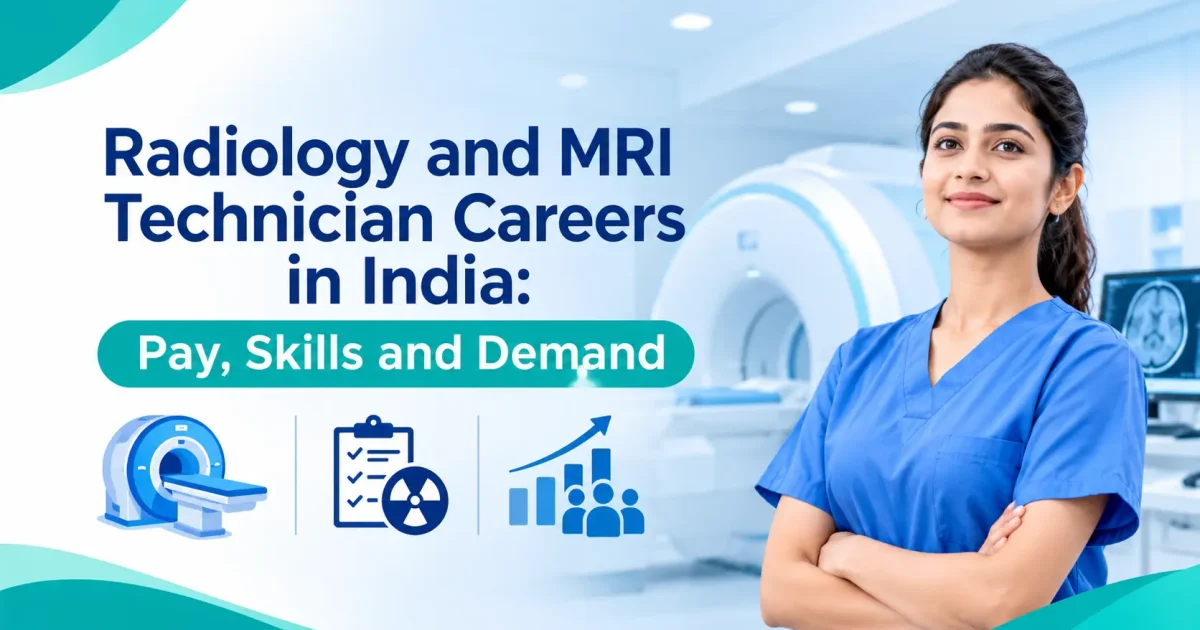
Radiology vs MRI technician jobs is not a contest between two titles. It is a choice between two technologies, two safety systems and two routes to higher pay. The supply side is also changing in 2026.
The Union Health Ministry’s Budget 2026-27 release states that allied health institutes in 10 disciplines will be set up and upgraded to create nearly one lakh skilled professionals over the next five years, and radiology is among the named disciplines.
That figure shows more trained entrants are coming.
It does not show how many imaging jobs will open. A reasonable expectation is that entry-level X-ray roles will become more competitive first, while CT, MRI and cath lab roles keep rewarding proven scanner hours. For that reason, certification and equipment experience will matter more than the job title.
This blog compares both paths, explains the BSc radiology scope, and gives modality-wise pay notes for X-ray, CT, MRI and cath lab roles. It also lists what diagnostic chains check before they hire, which helps candidates prepare and helps hospital HR teams hire better.
How the Two Roles Differ in Technology and Safety
Radiology vs MRI technician jobs look alike on a job portal, but the technology behind them is different. Radiography uses X-rays, which are ionising radiation. MRI uses a strong magnet and radiofrequency pulses, so no ionising radiation is involved. That one difference shapes training, safety rules, daily routine and the skills employers reward.
-
Radiology (X-Ray) Technician
A radiology technician, also called a radiographer, positions patients, selects exposure settings, operates X-ray equipment and checks image quality. Chest, bone, joint, portable and fluoroscopy studies make up much of the workload, so speed and accurate positioning matter.
Radiation protection is the safety focus, and facilities follow rules set by the Atomic Energy Regulatory Board (AERB). An x ray technician career also works like a base. With extra training and experience, radiographers move into CT and mammography.
-
MRI Technologist
An MRI technologist screens patients for implants, pacemakers and loose metal, selects coils and sequences for brain, spine, joint, abdomen and cardiac studies, and watches the patient through long scans.
The safety focus is the magnetic field, so screening discipline matters more than speed. Anxious patients and patients who cannot stay still need calm coaching, which becomes a daily skill.
Candidates searching for MRI technologist jobs India will notice that openings concentrate in diagnostic chains and larger hospitals, because MRI machines are costly and not every facility owns one.
-
Technician or Technologist?
Job posts use both words. Neither title is a senior version of the other. Both roles need anatomy, patient care and equipment knowledge. Neither role reports scans, since diagnosis and reporting stay with the radiologist.
Qualifications and BSc Radiology Scope
Imaging technician jobs usually list one of three routes: a diploma in radiography or radiology technology, a BSc in medical radiology and imaging technology, or a postgraduate degree for senior and teaching roles.
-
Diploma or Degree
A diploma gets a candidate into an X-ray room sooner. The BSc radiology scope is wider. Graduates have a clearer route to modality lead, supervisor and applications-specialist posts, and a degree can help when an employer shortlists for CT and MRI vacancies.
Most healthcare jobs for freshers in imaging begin in a general X-ray room, and a move to CT or MRI follows after the first year of supervised work.
A postgraduate qualification matters mainly for teaching, department management and vendor-side roles. It is not a requirement for a well-paid bedside career.
-
Safety Training and Document Checks
Radiation safety training matters for X-ray and CT work, and employers ask for proof of it. MRI roles need MRI safety training, which covers patient screening and zone control. Hospitals also verify degrees, certificates and past employment before an offer, which is why many HR teams run employee background verification for clinical hires. A candidate with clean, ready documents moves through hiring faster.
Radiographer Salary in India: Modality-Wise Pay Notes
Searches for radiographer salary India usually end with one number, and that number hides the real pattern. Pay changes by city, chain, shift pattern and modality, and published figures go stale fast. This section ranks what moves pay in each modality and leaves the final band to be confirmed against a written offer.
| Modality | Technology and safety focus | What lifts pay | Pay position |
| X-ray | Ionising radiation; exposure control and positioning | Fluoroscopy, mammography and portable experience; night-shift flexibility | Starting point in the department |
| CT | X-ray based cross-sections; contrast handling and dose control | Slice count handled, contrast injector skills, trauma and emergency experience | Usually above X-ray |
| MRI | Magnetic field and radiofrequency; implant screening | 1.5T and 3T exposure, advanced and cardiac sequences, clean screening record | Usually above X-ray; rises with 3T and cardiac work |
| Cath lab | Fluoroscopy with sterile procedures; assists cardiologists | Sterile technique, BLS and ACLS, emergency call readiness | Often among the higher bands for technologists |
Read the last column as direction, not a quote. A cath lab technologist with sterile technique and emergency readiness is paid for scarcity, while a general X-ray role is paid for volume. In radiology vs MRI technician jobs, the gap shows up less in the first offer and more in the second and third, once equipment experience is on the resume.
-
Certification That Moves Pay
Certification matters because it reduces what an employer has to train. BLS and ACLS help in cath lab and emergency imaging. Contrast-reaction management training helps in CT. MRI safety training is expected in MRI.
Vendor application training from equipment makers shows hands-on depth on specific scanners. International credentials such as ARRT matter mainly for candidates planning to work abroad.
-
Equipment Experience Counts More Than Years
Two candidates with four years of experience are not equal if one has run a 64-slice CT and a 3T MRI while the other has run a basic X-ray unit. Imaging chains ask which machine, which software version and which protocols a candidate has handled.
A resume should list scanner brand, field strength, slice count and the procedures performed. Specifics like these give a recruiter a reason to move a profile forward.
Skills Gaining Value in 2026
Imaging departments keep changing, and the skills named in openings are changing with them.
- Higher-field MRI and cardiac imaging: 3T systems are advancing, and cardiac sequence experience stands out.
- AI-assisted reconstruction and shorter protocols: Technologists who adjust sequences without losing image quality are valuable.
- PACS and RIS handling: Correct patient data and image routing prevent repeat scans.
- Teleradiology coordination: Reports are often read remotely, so image quality and complete clinical notes matter.
- Emergency readiness: Trauma CT and stroke protocols reward calm, fast technologists.
Radiology vs MRI Technician Jobs: Which Path Fits You?
Choosing between radiology vs MRI technician jobs comes down to three checks: the qualification already held, comfort with patient-facing work, and the pace of pay growth needed. Salary alone is a poor guide. Responsibilities, shift pattern and the training route deserve equal weight.
1. Begin in X-Ray When
Diploma holders and fresh BSc graduates usually find X-ray the easier first step. Rooms are plentiful, learning is quick, and trauma, bedside and fluoroscopy exposure helps later in CT.
2. Begin in MRI When
Some candidates start in MRI after a BSc or an MRI-focused course, without X-ray experience. First jobs are harder to find this way, because MRI rooms are fewer. The route suits candidates who prefer slower, detail-led scanning and enjoy patient coaching.
3. Switch to CT or MRI When
After 12 to 18 months of steady work, a technologist can aim for CT or MRI by completing safety training and requesting modality rotation. Candidates drawn to emergency and trauma work fit CT or cath lab better.
4. When Imaging Is Not the Final Goal
Some technologists find the scanner room is not where they want to stay. A move into diagnostics is the closest alternative, and lab technician jobs in India follow different entry routes, shift patterns and pay patterns from imaging.
Where Imaging Technician Jobs Are Opening
Imaging technician jobs come from four employer types: multispeciality hospitals, standalone diagnostic chains, cardiac and cancer centres, and mobile imaging units linked to teleradiology networks.
Diagnostic chains often hire several technologists together when a new centre opens with CT or MRI, so those openings fill quickly.
Newer centres in smaller cities often need technologists who can cover more than one modality. In those places, radiology vs MRI technician jobs may overlap, with one technologist handling both X-ray and CT, so broader exposure is rewarded.
Resume Mistakes That Cost Interviews
- Writing “MRI experience” without naming the scanner, field strength or sequences
- Leaving out safety training dates
- Skipping shift and on-call availability
- Listing duties instead of procedures and volumes handled
What Diagnostic Chains and Hospitals Should Check Before Hiring
Employers pay for equipment experience, so hiring checks should test it. A short checklist keeps screening consistent across centres and across radiology vs MRI technician jobs:
- Scanner exposure: brand, field strength, slice count and years on each
- Hands-on discussion: protocol choice for a common study, for example a knee MRI or a contrast CT
- Safety proof: radiation or MRI safety training records
- Shift fit: night, rotating and on-call readiness
- Verified records: degrees, certificates and past employment
Chains opening several centres together rarely have time to run these checks one candidate at a time. Staffton Health works with imaging employers on this kind of hiring, and hospitals or diagnostic chains can request modality-specific technologist profiles through the platform.
-
Get Imaging Job Alerts
Candidates can set up job alerts on Staffton Health for X-ray, CT, MRI and cath lab roles in their city. A complete profile with scanner details, certifications and shift preferences helps recruiters judge fit quickly.
Employers who want technologist profiles for a new centre or a replacement plan can share their requirements and receive matched candidates.
Conclusion
Radiology vs MRI technician jobs are not rivals so much as stages of one career. X-ray gives the fastest start. CT, MRI, and cath lab roles reward certification, equipment experience and patient-handling skills with better-paying positions.
With more trained entrants expected over the next five years, candidates who name their scanners, keep safety training current and move modality after a solid first year will stand out.
Employers gain the same way. Hiring against scanner exposure and verified records is more reliable than hiring against a job title. Create a job alert on Staffton Health, or share an imaging hiring requirement, to start with matched profiles.
FAQs
1. Which is better in radiology vs MRI technician jobs?
Neither wins on its own. MRI roles usually pay more once a technologist has hands-on scanner experience, while X-ray roles offer more openings and an easier start.
2. What is the BSc radiology scope in India?
A BSc in medical radiology and imaging technology opens roles in X-ray, CT, MRI and cath lab, and gives a clearer path to modality lead, supervisor and applications-specialist positions.
3. How much does a radiographer earn in India?
Radiographer salary india depends on city, chain, modality and shift pattern. Entry X-ray roles sit lowest, while CT, MRI and cath lab roles are usually higher. Ask for the band in writing before accepting an offer.
4. Can an X-ray technician move to MRI?
Yes. Most do it after 12 to 18 months by completing MRI safety training and requesting rotation, or by applying to chains that train on the job.
5. Do certifications matter for imaging technician jobs?
Yes. BLS, ACLS, contrast-reaction and MRI safety training reduce employer training effort, and vendor application training shows hands-on depth on specific scanners.